
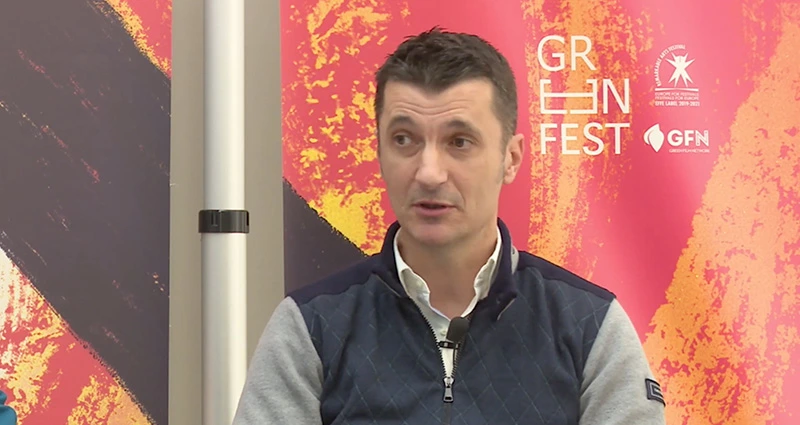
Author: Aleksandar Milijašević
Complex tenders, mandatory co-financing and the legal status of facilities can prevent energy-vulnerable households from using support measures. Aleksandar Macura from RES Foundation warns that more accessible programs, more responsible institutions and a system that measures real changes in citizens’ lives are needed for a just energy transition.
The existence of subsidies for energy rehabilitation does not necessarily mean that citizens who need support the most can use it. For a household that does not have enough money for its own participation, finds it difficult to obtain information or does not meet the administrative requirements, the public invitation may remain unavailable even when funds are provided for it.
Aleksandar Macura from RES Foundation points out exactly the difference between formally available support and the actual possibility of its use, answering Dialog Net’s questions about the experiences of working with energy-dangerous households, women in rural areas and local self-governments.
His answers open up a question that goes beyond individual programs: is the success of the energy transition measured by the number of calls for tenders and implemented activities or by the changes that citizens can really feel?
When the information exists, but does not reach the user
“The lack of effective support information is the first barrier to accessing support measures,” says Macura.
According to him, information about available programs can be published without reaching potential users. It particularly points to citizens who do not use the Internet enough or live outside municipal centers, where information spreads more slowly.
Even when they learn about the possibility of support, citizens must understand the conditions of the competition and the steps required to apply.
“Public calls conducted by local governments are very demanding,” Macura says.
At the same time, he does not question the efforts of people who participate in informing citizens. He also sees the problem in the complexity of the competitions themselves, which can be an obstacle for people with a lower level of functional literacy.
This means that the publication of information and a formally open application procedure are not sufficient indicators of the availability of a measure. It is also important whether potential users can find out about it, understand the conditions and successfully go through the procedure.
Money and the status of the facility as additional obstacles
In addition to information and administrative requirements, Macura singles out two obstacles that can directly decide who will receive support: the mandatory financial participation of the household and the legal status of the facility.
“Ultimately, any co-financing required from vulnerable groups can be a decisive barrier to access to support measures.”
As part of the “Clean energy and energy efficiency for citizens” program, the Ministry of Mining and Energy has foreseen the co-financing of household energy rehabilitation measures through public calls for local governments. For socially vulnerable citizens, the program for 2025 provides support for up to 90 percent of the value of energy rehabilitation.
Although a higher percentage of the subsidy reduces the amount that the beneficiary needs to provide, it does not in itself indicate whether the household has the money for the remaining expenses. That is why the amount of the subsidy and the actual financial availability are not the same.
In the program documentation of the Ministry for the year 2025, among the conditions for applying for energy rehabilitation measures, the legal construction of the building is specified, along with requirements related to the status of the applicant and the use of the building for housing.
Macura warns that the requirement of legality may prevent access to support for many property owners.
However, the available documentation does not make it possible to determine how many households were actually left without support due to this condition. Also, the conditions of one energy rehabilitation program cannot be automatically attributed to all energy assistance measures.
It is important to distinguish subsidies for improving the energy efficiency of households from the special status of an energy-vulnerable customer, which is realized according to different rules and enables certain concessions in paying for energy.
How many people can’t heat their home enough?
The data of the Republic Institute of Statistics show that the problem of the possibility of adequate heating of households is not limited to individual cases.
According to the results of the Survey on Income and Living Conditions for 2025, 9.3 percent of people in Serbia lived in households that could not afford adequate heating of the apartment.
The same statistical source shows that 36.1 percent of people lived in households that could not cover the unexpected expense.
These indicators indicate different dimensions of material deprivation. Nevertheless, the impossibility of adequate heating is not in itself a complete measure of energy poverty, nor can it be concluded from it how many citizens meet the conditions for specific support programs.
It does not even show whether certain subsidies contributed to improving the position of their beneficiaries.
For such an assessment, it is necessary to link data on living conditions with information on who uses support measures and what changes occur afterwards.
The number of covered citizens is not the same as the change in their position
In the document Communication on Engagement 2024–2026, which covers the period from September 30, 2024 to September 30, 2026, RES Foundation presented activities related to energy poverty, inclusion of vulnerable groups, and local energy and climate planning.
The document includes work on a model of support for energy-dangerous households in ten municipalities, advisory activities with more than 100 women from rural areas, and processes of local energy and climate planning in nine local governments.
These data speak about coverage and implemented activities. By themselves, however, they do not allow the conclusion of how many households received support, reduced energy costs or improved housing conditions.
The difference is also important for evaluating public policies. The number of citizens informed, consultations held or plans drawn up shows what has been done, but not necessarily what has changed.
Who should ensure that the support reaches the citizens?
The existing energy rehabilitation program involves the cooperation of the Ministry of Mining and Energy and local governments. The Ministry of Mining and Energy and local self-governments participate in the financing and implementation of the program, with local self-governments announcing public invitations for citizens according to the appropriate program rules.
Such division of labor raises the question of responsibility for the actual availability of support: who should provide understandable information, procedures that citizens can master, and help for those who have the greatest difficulties in applying?
Macura looks at the problem more widely, through the issue of institutional responsibility.
“Legal, political and professional responsibility for carrying out work in the name and on behalf of citizens are prerequisites for thinking about steps for improvement.”
Among the necessary changes, he mentions decentralization and a different organization of the energy sector, but in order to support energy-poor citizens, he particularly emphasizes simpler procedures and immediate work in the field.
According to his proposal, the knowledge of local circumstances that organizations and people in direct contact with vulnerable households should use more in the provision of assistance and decision-making.
In this context, he mentions centers for social work, associations that bring together vulnerable groups, civil society organizations and religious communities as possible sources of information and participants in the implementation of public policy.
It is a proposal of a way to organize support, not an assertion that all the mentioned organizations already have legal powers to decide on the rights of citizens.
In contrast to the approach that starts only from the published competition and expects citizens to apply themselves, such a model would imply more active recognition of households in need of help and simpler procedures for obtaining it.
Success does not end with the announcement of the competition
Support for energy-vulnerable households can be formally available, but a part of the citizens still cannot use it. Information, the complexity of the procedure, own financial participation and the status of the facility can decide on access just as much as the amount of the subsidy itself.
That is why it is not enough to know how many funds have been allocated, how many public calls have been announced or how many citizens have been included in informational activities to assess success.
It is necessary to determine who was able to apply, who received support, what obstacles remained and whether the beneficiaries’ living conditions changed after the implementation of the measures.
Macura’s answers point to the need to view energy poverty as a matter of availability of public support, institutional accountability and measurable results.
Therefore, the fairness of the energy transition cannot be assessed only by what measures exist, but also by who can actually access them and what changes with their application.