“We didn’t get a great response, so now we wanted to change our approach, to help those people, to empower those people, and that’s why…” [1]
That is why they organized a special presentation in Niš for socially vulnerable citizens. To change their approach to get different results. There are other ways to inform and then empower our most vulnerable fellow citizens to access the help for energy rehabilitation offered through the “Clean Energy and Energy Efficiency for Citizens” project.
Until we figure out some ways to get to them in a simpler, more useful way.
Taxpayers of the Republic of Serbia co-finance the energy rehabilitation of households throughout the Republic of Serbia[2] through a five-year project of the Ministry of Mining and Energy and the World Bank[3] “Clean energy and energy efficiency for citizens”, which provides subsidies to households for implementing energy efficiency measures. The project is implemented through public calls announced by the Ministry of Mining and Energy and local self-government units. Fifty million dollars have been secured from the loan, while several tens of millions of dollars more[4] will provide local self-government units in their budgets.
By focusing on family houses and users of solid fuels, the project is planned to provide households with lower incomes to local self-government units with lower incomes, covering part of their contribution to the program and thereby increasing the share of this group of municipalities as well as a larger share of grants as additional support for social inclusion at the household level.
For the second year in a row, RES Foundation is analyzing the results achieved by implementing this important project in order to learn how to spend public money in the most efficient and useful way now and in the future in Serbian society of good energy, to help those who cannot help themselves, just as this project planned.
We hope that soon we will be able to see all the collected data related to the implementation of this extremely important scheme on the project website https://www.cistaenergija.rs/. The transparency of these data would enable learning from experience for all future creators of the new Serbian society of good energy.
We believe that local governments, the Republic of Serbia, the International Bank for Reconstruction and Development and other factors will see the importance of the transparency of all data related to the spending of public funds for energy rehabilitation measures in households implemented through this pilot project. We believe that this knowledge will encourage them to make all the numerous data available to the professional and lay public. We promise to update our analysis when all data is publicly available.
Until then, we recommend your attention to our updated analysis. This analysis, except where otherwise indicated in the document, is based on data that could be found on the websites of the project, the Ministry of Mining and Energy, LGUs participating in the competition, other portals and the Report of the State Audit Institution (DRI) on the effectiveness of the implementation of this project.[5]
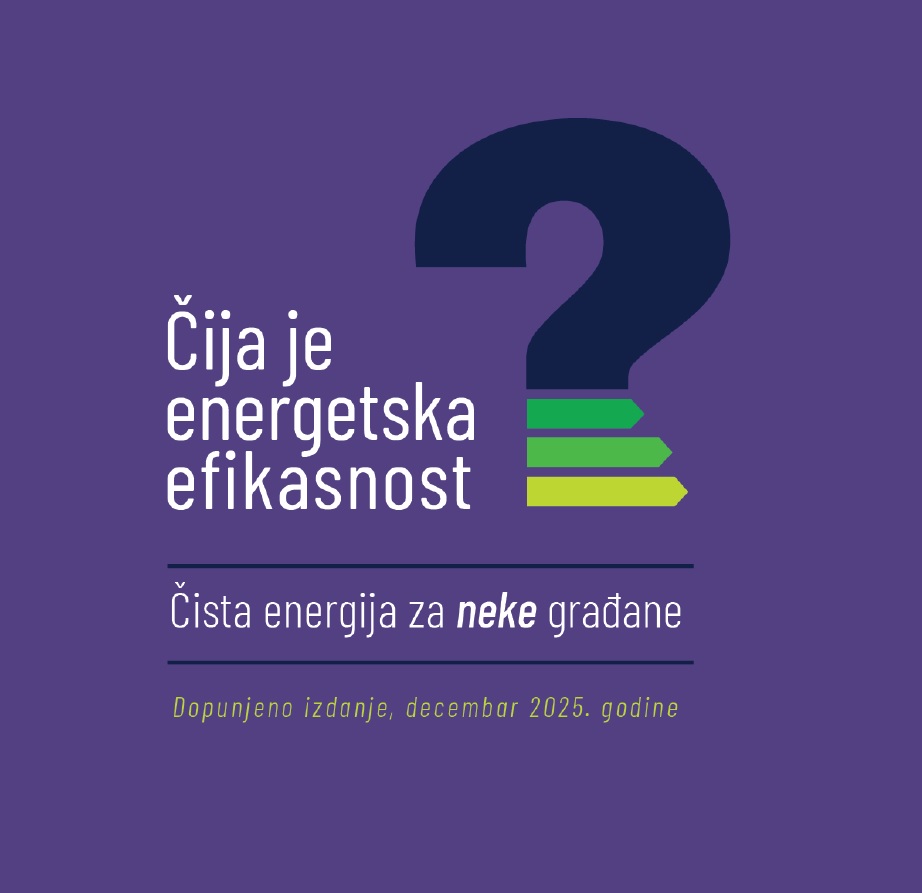
Read the analysis Clean energy for some citizens – updated edition, 2025 (Serbian language)
[1] Adrijana Ranđelović, energy manager of the City of Niš at a meeting dedicated to informing socially vulnerable citizens https://niskevesti.rs/poziv-za-energetsku-sanaciju-za-socijalno-ranjivo-stanovnistvo/
[2] https://www.cistaenergija.rs/
[3] EBRD
[4] The exact amount will also depend on the structure of the local governments that receive support
[5] https://www.dri.rs/izvestaj/14464