Poor air quality is one of the leading environmental risk factors for population health. This fact encouraged the members of the Department of Medical Sciences of the Serbian Academy of Sciences and Arts to organize the scientific conference “Impact of Air Pollution on Health: Mechanisms, Consequences and the Necessity of Reducing Negative Effects”. The conderence was held on Wednesday, November 4 in the SANU Grand Hall.
The reduction in life expectancy due to air pollution is similar to that caused by smoking tobacco, while it exceeds it in populations that are long-term exposed to high levels of air pollution. According to data from the World Health Organization (WHO), 99 percent of the world’s population breathes air that contains pollutants in concentrations above the WHO recommended values. This situation leads to a global increase in mortality. The WHO estimates that 6.6 million deaths per year are attributed to air pollution alone.
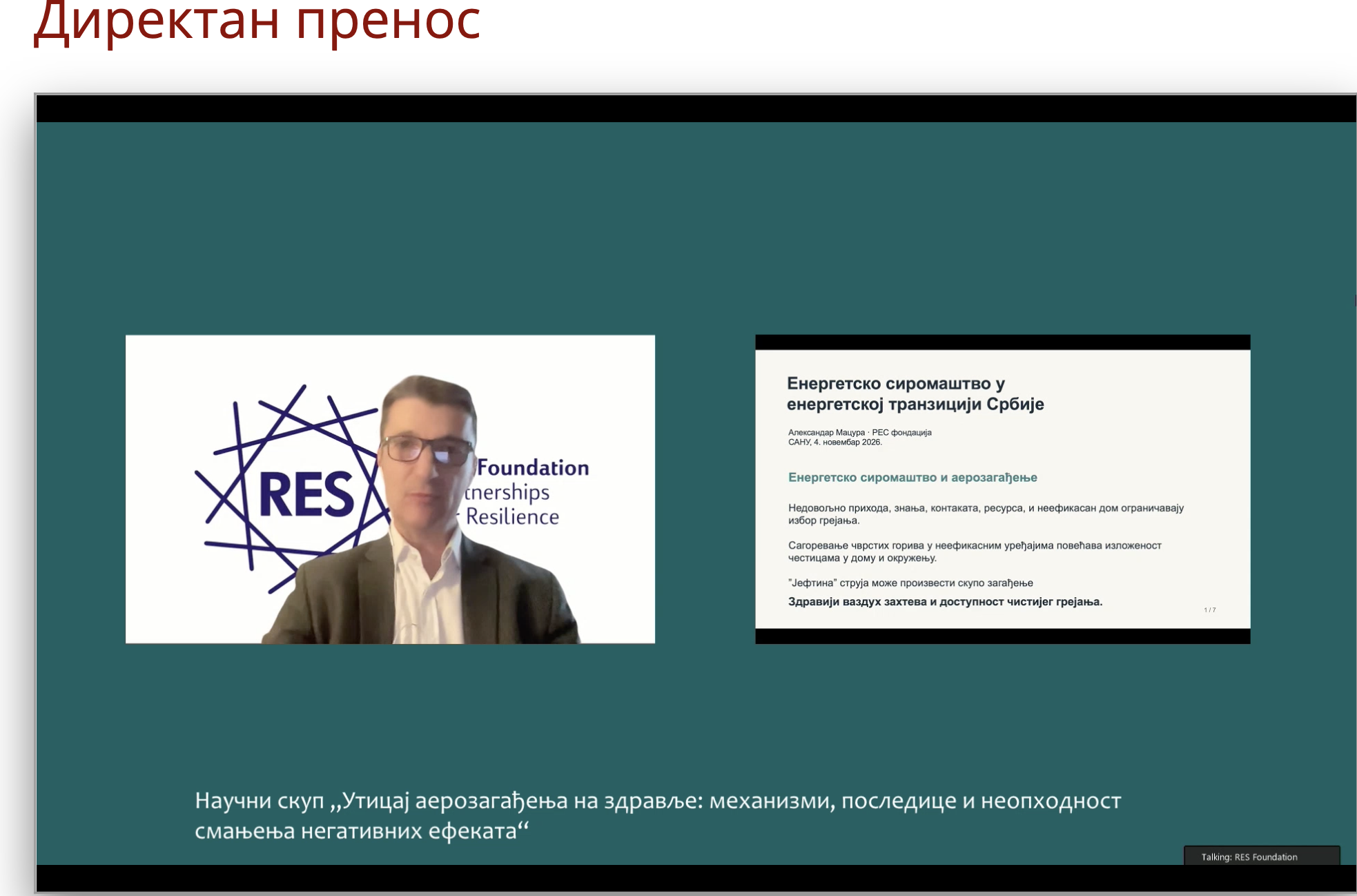
Through four series of lectures, the scientific conference presented both medical and public health aspects of air quality protection and improvement. Programme director of RES Foundation, Aleksandar Macura, participated in the third series of lectures, the topic of which was the possibilities of overcoming air pollution: systemic, technological and local measures, and the aim of which was to present practical measures – from the systemic to the local level. Macura spoke about energy poverty in the energy transition in the Republic of Serbia. He emphasized that not everyone can finance the transition by themselves, and that the new political moment is another opportunity to review how we decide on public money and who is responsible for the result. His conclusion was that money is not the scarcest resource, but it is the ability of the system to recognize public benefit, direct money towards it in a quality and responsible manner and measure the result.
Based on the data presented by the participants of the scientific conference, the goal is to reach a critical discussion about public policies, institutional roles and responsibilities, and the path that should be followed in order to reduce the negative effects of air pollution on human health.