
Source: Vreme
Author: Aleksandar Macura, co-founder and programme director of RES Foundation
We know how many kilometers of roads have been built. We know how many cars are registered. We know how many buses there are. What we know much less about is whether the citizens of Serbia really live better because of this
“One would imagine, if I had had the least reflection upon my mind of my circumstances while I was making this boat, I should have immediately thought how I was to get it into the sea: but my thoughts were so intent upon my voyage in it, that I never once considered how I should get it off the land.”
Robinson Crusoe really wanted to escape from the desert island. He invested a lot of time and effort to build a boat that could accommodate 26 people, and which was only a hundred meters away from the shore. Robinson, however, was alone and there was no way he could get the boat to the water and save himself. Today, exactly that – the denied possibility of good choices for solving important transport needs can be called transport poverty.
How many of our public policies are like a boat that has been built but cannot reach the water? Do the policies we enact and implement, and the infrastructure we build at the expense of future generations, help people get to work, school, doctors or other important services? Is transportation available? Is it too expensive? Reliable? Is it adapted to the needs of citizens? Can all citizens use the roads and railways that we see on the maps and in the credit arrangements of the state? Can all citizens safely use buses and trains where they are available? Can all citizens safely enter public transport? A large number of citizens in Serbia cannot take the trips they need or want very much. Many other citizens achieve some of their desired or needed trips, but spend a lot of time or pay costs that prevent them from achieving their other needs and desires.
Transport poverty has become an important topic of European policies in recent years. The European Union associates it with climate policy and social justice. The obviousness of climate change, as well as the complexity and uncertainty of fossil fuel supply, reduce doubts about the decarbonisation of transport. It will not be successful, however, if the new policies do not help those who already have the least opportunities to move.
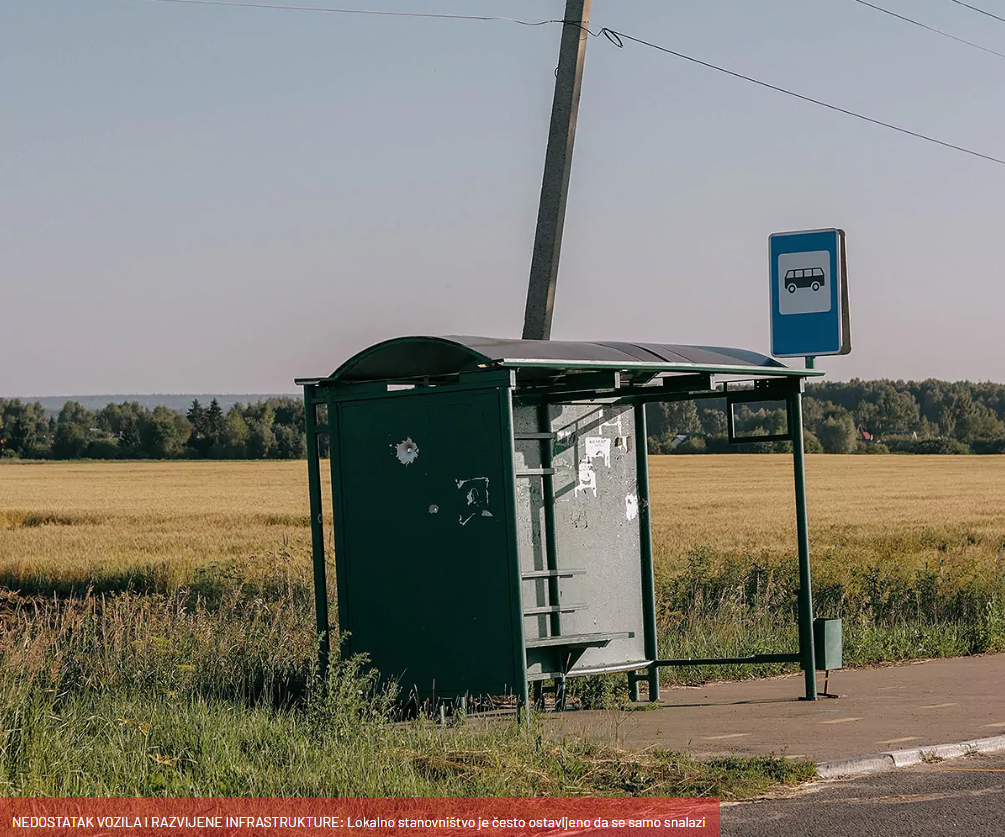
The term “transport poverty” is still not used in Serbia. It does not exist neither in laws, nor in strategies, nor in local development plans. RES Foundation’s research shows that transport poverty exists in Serbia – even when we don’t call it that name – and that a large number of our fellow citizens face it every day.
The research was carried out as part of the project “Towards just and climate-neutral mobility”, which is also implemented in Croatia, Hungary and Germany and is part of the European Climate Initiative (EUKI) funded by the German Government. During the research, we conducted a review of domestic literature and noted numerous characteristics of transport poverty in terms of transport accessibility, mobility in rural areas, gender equality, social exclusion or availability of public services. Research on rural areas shows that residents often give up traveling because adequate transportation does not exist. Studies on women indicate that they use public transport much more often because they have no alternative. Papers on persons with disabilities document numerous obstacles in the daily use of public transport. They all describe the same problem, but without a common name.
A few years ago, the State Audit Institution (DRI) determined that around 40 percent of local self-government units did not organize urban and suburban public transportation1. About one million inhabitants live in those municipalities and have to rely on long-distance lines, their own car or help from family and neighbors. At the same time, there are no minimum standards that would determine how often public transport must operate, which territories it must cover, or how its quality is measured.
Even more impressive are the findings of the audit of health centers in underdeveloped municipalities. In Babušnica, Blace and Medveđa, the problem is not only the lack of doctors2, but also the fact that the distance, mountainous terrain and traffic connections mean that a large number of citizens cannot reach health care in a time that is considered medically acceptable. The woman from the example in the antrfile, who may have missed preventive examinations or treatment at an early stage due to bad choices, may also be late for emergency intervention. Then transportation becomes a matter of life and death, a health issue, not an infrastructure issue.
AVAILABILITY IS MORE IMPORTANT THAN PRICE
Public transport that is fully paid for by taxpayers and not users (so-called “free public transport”) can be a good solution in some areas. In recent years, several cities in Serbia have introduced different models of free transportation, from the universal model in Belgrade to targeted benefits for pensioners, students or people with disabilities in other cities. However, if the bus does not run at all or runs twice a day, a ticket of zero dinars does not solve much. Availability is more important than price.
The program of the Ministry of Rural Welfare for the allocation of grants for the purchase of minibuses3 represents one of the few direct attempts by the state to respond to the problem of rural mobility. The value of the program is that it recognized that the poor connectivity of villages makes it difficult to access health, educational, administrative and other services. However, this public policy measure is limited because it only finances the purchase of vehicles, while the costs of registration, insurance, fuel, drivers, maintenance and long-term legal and quality organization of the service remain with local governments. We do not know what the future fate of this potentially important, but partial and institutionally unstable measure will be. We know that the program for 2025 has not been implemented because the Ministry of Finance has not received the consent to assume budgetary obligations. If the publicly available footage is correct, we saw minibuses with the inscription “Ministry of Rural Welfare” parked in Belgrade during the recent rally “Serbia – one family”4. Some important needs for transportation of family members were fulfilled. Therefore, and not only because of this, the public should know where these vehicles are located, who drives them and how many actual rural trips they enable.

CHANCES FOR A SERIOUS TRANSPORT POVERTY REDUCTION POLICY
How does the issue of transport poverty now intersect with the issues of decarbonisation and reducing dependence on fossil fuels as a matter of safety and security of supply? In the public eye, the decarbonization of transport is mostly identified with electric buses or electric cars. These are important steps, but they are not enough. If one invests only in new vehicles and ignores service availability, it is possible to get a “greener” but not a more just transportation system. An electric bus may not be able to pass through the countryside like a diesel or gas-powered bus, and may be inaccessible to people with disabilities. Robinson’s boat could have had a motor, but it wouldn’t have helped him much on land.
A real decarbonization policy should also answer other questions: whether people can give up cars, whether they have a safe pedestrian or bicycle infrastructure, whether there is reliable public transport between the village and the municipal center, how long it takes to get to a school or health center. Some of these issues are entirely political issues. Transport poverty, like all other important social issues, is a political issue. Such issues cannot be resolved by non-political or apolitical methods.
CAN SERBIA AT ALL LEAD A SERIOUS POLICY TO REDUCE TRANSPORT POVERTY
Technically it can. Our research shows that numerous elements of the future policy already exist in the laws. Education regulations recognize that the state should fund the transportation of children when distance is an obstacle to schooling. The health system already takes distance and accessibility into account when planning the network of facilities. The Sustainable Urban Development Strategy talks about accessibility, vulnerable groups and differences between urban and rural areas.
What is transport poverty
Let’s imagine a female pensioner from a mountain village in the Zlatibor district. She does not own a car, and the bus to the municipal center runs twice a day. When she has a doctor’s appointment at 11 a.m, she has to take the bus at 6:30 a.m. and wait for several hours. If the examination is delayed or she has to perform additional tests, she risks missing the last bus and being left without transportation home. In theory, health care can exist only fifteen kilometers from her home. In practice, access to this service depends on the timetable, weather conditions and the help of relatives or neighbours.
Why is this transport poverty? The problem for this citizen is not physical distance, but the lack of accessible and reliable transportation. Such cases illustrate what the literature calls “suppressed mobility” – when people give up on trips or postpone them because the organization of transportation is too complicated or expensive for them.
Let’s imagine a wheelchair user from Belgrade who wants to use public transport to go to work. The road from home to the station may not have a designated ramp or some vehicles may not be adapted, and information about which departures are accessible is not readily available. As a result, he often uses taxis or relies on family members for transportation. When he has no alternative, he simply gives up some activities. This example directly reflects the findings of the study on the mobility patterns of persons with disabilities in Serbia, which shows that a significant number of respondents do not use certain types of public transport precisely because of accessibility barriers.
Why is this transport poverty? Public transportation exists, but it is not usable for this citizen. This shows that the availability of transportation should not be measured only by the existence of the line, but also by the possibility that different groups of the population actually use it.
Let’s imagine that we have built a railway line used by trains that stop in the town of Vrbas in Bačka. Let’s imagine that using these trains reduces the time needed to get to Novi Sad or Belgrade, where the girl from Vrbas wants to go to college. Let’s imagine that she can enjoy a discounted fare on that train. Now let’s imagine that the station is moved outside the inhabited place itself, that there is no public transport to it. Let’s imagine that the station cannot be reached safely on foot or by bicycle through the plain because there are no sidewalks or bicycle paths, and the existing IIB state road number 305 Vrbas – Kucura – Savino Selo is not safe for walking and cycling. Well, we don’t have to imagine this because honest professionals in cooperation with responsible representatives of the citizens of Vrbas managed to achieve just such a situation.
Why is this transport poverty? A girl from Vrbas can’t get to the station if she doesn’t have a car, driver’s license or money for a taxi to get to and from the station.
The problem is not that the laws do not recognize anything. The problem is that none of these parts are connected into a single public policy.
The preparation, implementation and monitoring of policies that address problems related to transport poverty require data, institutions and responsibility. It is necessary to know how many people cannot get to a doctor, how many households spend a disproportionate share of their income on transportation, how many villages do not have a proper bus connection, and how many students or elderly people give up traveling due to lack of transportation. We don’t have all that data today. We know how many kilometers of roads have been built. We know how many cars are registered. We know how many buses there are. We know much less whether citizens really live better because of it.
Developing policies that address transportation poverty begins with the recognition that equal access to work, school, doctors, and public services is a basic human right that allows citizens access to diverse opportunities. The first step should be surprisingly modest: choose what to measure and start measuring some of what is seen today. What is not measured almost never becomes public policy.
We said that public policy requires data, institutions and responsibility. We have said something about data in this text. Robinson looked at his opportunities himself, thought of an activity, invested his resources, and with immediate insight determined that he had ruined himself. We do not yet know what our institutions will determine.
1 Functioning of urban and suburban passenger transport, DRI
2 Report on the audit of the regularity and expediency of operations in the Health Center “Dr. Jovan Ristić”, Babušnica: Regularity and efficiency of managing the capacities of health centers in underdeveloped municipalities; Report on the audit of the regularity and expediency of operations in the Health Center Blace, Blace: Regularity and efficiency of managing the capacities of health centers in underdeveloped municipalities; Report on the audit of the regularity and expediency of operations in the Medveđa Health Center, Medveđa: Regularity and efficiency of managing the capacities of health centers in underdeveloped municipalities.
3 Regulation on the determination of the Grant Program for the purchase of minibuses for the needs of rural population transportation in the territory of the Republic of Serbia for the year 2025.
4 https://x.com/Bez_korupcije/status/2070904275912261897