#RESTalksCOP is a COP30 interview series created to bring people closer to the United Nations Framework Convention on Climate Change (UNFCCC) process. Through conversations with negotiators, experts, and civil society, we explore diverse perspectives and behind-the-scenes insights. Recorded on the ground at the 30th Conference of the Parties (COP30), these interviews offer a time-capsule look at the people and stories shaping today’s climate negotiations.
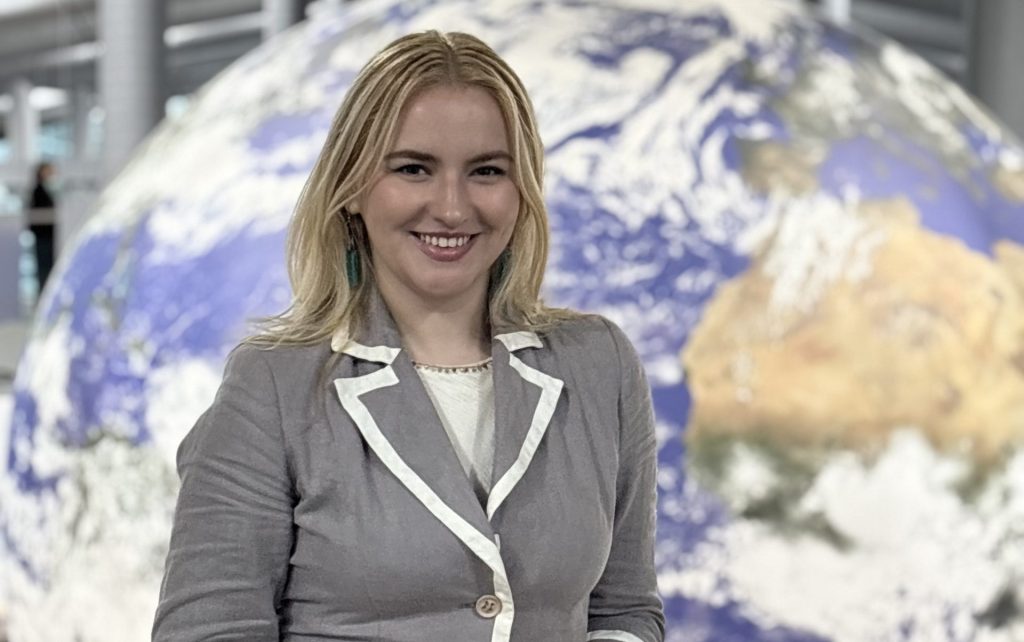
We spoke with Mara Ghilan, Policy Co-Lead in the Official Children and Youth Constituency (YOUNGO), whose work focuses on the Global Youth Statement (GYS) and intergenerational equity. At COP30, Mara is pushing for the formal recognition of the GYS—the world’s largest youth-led climate policy process. In this conversation, she reflects on the role of youth in the UNFCCC, the importance of meaningful participation, and the unique challenges facing young people in Eastern Europe.
Mara Ghilan: My name is Mara. I am one of the Policy Co-Leads in YOUNGO. My work focuses on the GYS segment, but also on the nationally determined contributions (NDCs), the Global Stocktake (GST), and as the former Contact Point of the Human Rights Working Group, I keep this topic close to my heart as well. Outside of YOUNGO, I am a consultant for a political intelligence organization where I advise organizations on policy and advocacy.
Zvezdana Božović: How long have you been engaged in the UNFCCC process?
Mara: My first experience was at COP26 which I have followed online for my work. My academic focus was also on global environmental governance and my dissertation for my Master’s at the London School of Economics was focused on intergenerational justice within the UNFCCC. My first in-person COP was COP27 in Sharm el-Sheikh, which I attended with the Global Alliance of Universities on Climate (GAUC). It was such a meaningful and formative experience that really pulled me into the youth climate movement. My focus in my advocacy work since then has been on the UNFCCC process. This is my fourth COP.
Zvezdana: So this year what are you following, what are you focused on most in the negotiations
Mara: This year, my main goal is to obtain the recognition of the GYS and the five key priorities that it contains. We’re building on really good precedents. The GYS, which is the largest youth-led climate policy process in the world, brings together 30,000 children and youth from more than 130 countries. It’s a really meaningful and participatory process and it’s been recognized already at COP26, COP27, and COP28. Unfortunately, at COP29, in the absence of a cover decision, it was quite difficult to obtain this recognition. We really want to prove that this was an exception. The recognition of the efforts of children and youth both through the GYS and the annual Conference of Youth (COY) and the more than hundred Local Conferences of Youth (LCOYs) is really important because we are doing this out of passion and with very limited resources, facing significant power imbalances. This recognition gives us energy and faith to continue doing this.
Aside from the GYS and the conferences I mentioned, the most substantial aspect is the fulfillment of the demands regarding the update of the NDCs and full implementation of the outcomes of the first GST, as well as the fossil fuel phase-out – one that is fair, funded and fast. Then we have demands on adaptation. We see escalation of adaptation as a moral priority and we also want to see more balance between mitigation and adaptation finance. We have requests specifically on intergenerational equity. This follows on the advisory opinion of the International Court of Justice (ICJ) which lays out very clearly the obligations of states towards intergenerational justice in relation to climate change. It’s about time for the UNFCCC process to move its commitment to intergenerational equity, which is stated in the preamble of the Paris Agreement, into operational text. In practice, this means developing mechanisms that can really track progress on this because at the core of the climate crisis lies huge injustice towards younger and future generations. We also have demands on climate finance. What we see after the New Collective Quantified Goal on Climate Finance (NCQG) decision last year, we have a mechanism in place, but there isn’t enough funding contributed to existing mechanisms. The focus is on using mechanisms that have already been set in place and fulfilling the commitments that Parties have already made.
Zvezdana: It sounds really comprehensive.
Mara: Yes. There are many other demands in the GYS. It’s a document that is relevant beyond the COP, so I invite everyone to read it. It has more than 20 thematics, and also comes in several different versions, including a very short one with just the 5 key priorities. It’s a repository of demands. We know that not all of those demands will be fulfilled at COP30, and some cannot be fulfilled here, but at the national and local levels. So the journey continues beyond the COP.
Zvezdana: To go back to the local and regional level. You’re from Romania which is in Eastern Europe and a Balkan country. This region is quite underrepresented in the process. At the same time, we know that this region is one that will most likely face some of the most severe climate impacts in Europe, and one that is one of the most vulnerable parts of the continent. How do you see the positioning on this and where should we go from here?
Mara: In terms of the process itself, I think it’s really important to understand that Eastern Europe has a different history, a different past. It’s a not-so-distant past, a recent past that defines our present. Most countries in Eastern Europe have gone through a very difficult transition from communism into free market capitalism. There are specific challenges around our political systems and the strength of our democracies. However, these are challenges that we can find in other regions of the world as well, but I think it’s important to keep in mind this distinctive experience when we look at Europe as a whole. This distinction also translates in the opportunities we have, the approach we have.
To answer your point on vulnerability, if you look at the map of risks in Europe, we are indeed going to be facing severe impacts and the increase in temperature is more significant in Romania, and Southeastern Europe overall. We see extreme hydric stress, droughts, risks of floods and wildfires. These risks can come hand-in-hand. For example, after extreme drought, there comes heavy rain. We had victims this year in my country due to flash floods that have affected different regions throughout Romania. We also have desertification in the southern parts, and productive agricultural land is lost every year due to this. I don’t think there’s really so much awareness of the kinds of challenges that my country is facing and our region is facing in this space, you know?
I must also acknowledge that Romania is in a privileged position as a member of the European Union. If I look at the country that I grew up in and the country that Romania is now, there are significant differences. That comes from the colossal investments of European funds and the continuous support to our institutions and democracy, which I think puts us in a better position compared to other countries in the region. I want to also highlight Moldova’s case which sees the same risks and a decrease in productivity up to 50% on some of its crucial crops, and it’s really concerning for a small country to go through these challenges without the support mechanism that Romania has for example.
Zvezdana: How do we ensure better inclusion of youth from this region, both in the UNFCCC process, but also on a national level? Which obstacles do Balkan and Eastern European youth face in being able to engage?
Mara: In terms of our participation as children and youth from Eastern Europe, I think there are several challenges, some of which you can find in different regions as well. We see a lack of transparency that make processes not very welcoming to participation, inconsistent communication between youth representatives and authorities, and the lack of capacity from both sides. From our side it’s a lack of capacity to engage, and from the authorities’ side it’s a lack of capacity to create spaces for youth. That’s an opportunity for collaboration on its own. Another one is limited funding as youth are many times expected to participate in volunteer roles without financial support for travel or for their work which is particularly challenging for an age group that doesn’t have much financial independence, if any. That’s also something that can be found across regions.
Specific to Eastern Europe, we continue to have this culture of seniority where older people have the last word and hold the leadership positions. We respect our elders, and that’s something I think translates into the political aspect as well. At the same time, this is something we can also challenge because young people have so much to provide that other generations can’t. First and foremost, we have lived experience. All young people know what it’s like to be young now, under these circumstances. The second thing we can offer is innovation and creative thinking, the ability to bridge solutions, to bridge topics, to find resources even when there are hardly any. I think our participation here is a testament of that. Then we have the generational aspect – the fact that we are going to be the most affected by the climate crisis. The younger we are, the longer we live, the bigger the part of our life we will live under extreme circumstances. This gives us additional impetus. Of course, we want to see intergenerational cooperation and politicians thinking about their children and their grandchildren in their decision-making, but that doesn’t replace real participation and representation.
Zvezdana: Thank you so much for taking the time to talk to me! If people want to know more about your work or read the GYS, where can they find you?
Mara: I can be found on social platforms. On Instagram it’s just my name mara.ghilan. On LinkedIn it’s just my name. When it comes to the GYS, you can find it on my profile and also on the YOUNGO page, so make sure you follow youngo.unfcccc on Instagram.
Interview conducted on 14 November 2025