
#RESTalksCOP is a COP30 interview series created to bring people closer to the United Nations Framework Convention on Climate Change (UNFCCC) process. Through conversations with negotiators, experts, and civil society, we explore diverse perspectives and behind-the-scenes insights. Recorded on the ground at the 30th Conference of the Parties (COP30), these interviews offer a time-capsule look at the people and stories shaping today’s climate negotiations.
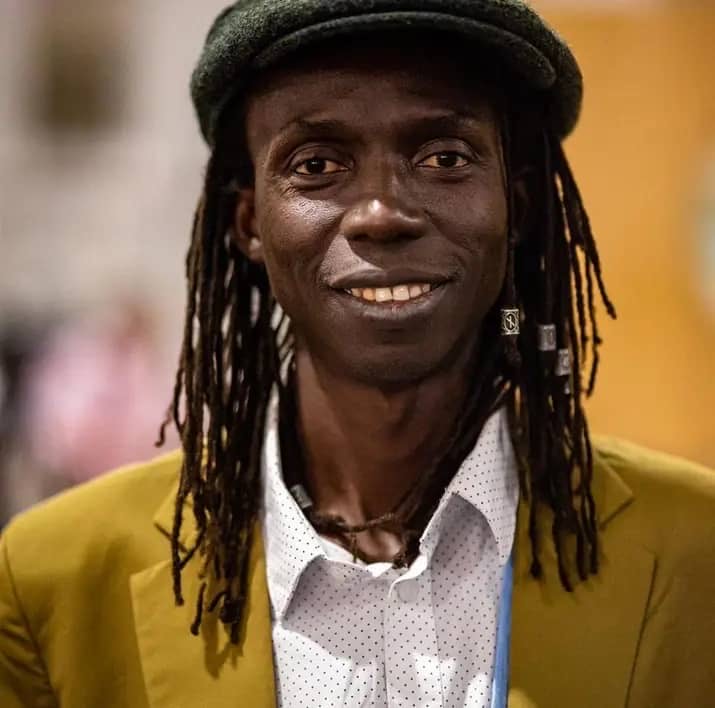
We spoke with Malang Sambou, the Gambia’s lead negotiator for the Mitigation Work Programme (MWP) and Just Transition. In this conversation, he reflects on the political realities of mitigation, the equity concerns shaping African Group positions, and what the future of the MWP could mean for developing countries as COP30 confronts the urgency of implementation.
Malang Sambou: My name is Malang Sambou from the Gambia. I am the lead negotiator for the Gambia for the Mitigation Work Programme (MWP) and Just Transition. Equally, I run an NGO and I am the Executive Director of Mbolo Association, which is a women-led association in the Gambia dedicated to training young women on renewable energy technologies.
Zvezdana Božović: How long have you been involved in the UNFCCC negotiations?
Malang: I’ve started my first COP in Paris, as a participant, not as a negotiator. Then I started my journey in the negotiation process since Madrid. I started with Article 6. Then it was in Glasgow, when I started following mitigation.
Zvezdana: What are you following this year at COP30?
Malang: I have the privilege of following one of the most difficult agenda points – the Mitigation Work Programme and Just Transition.
Zvezdana: Following the MWP, have you noticed any big points of divergence between Parties or groups in the process?
Malang: Yes, there are a lot of differences, because mitigation is all about cutting emissions. Cutting emissions is not the will of all Parties, especially the bigger emitters and then polluters, where the big industries are. This is a way of life, a style of life, which means cutting down the usage of communities who partake in all kinds of activities that we are doing daily, specifically in the aviation industry, shipping industry and bigger industries that are steel factories and large. So obviously this is a very, very complicated thematic area that needs attention.
Zvezdana: Would you say that there are also any points of agreement or consensus that you have already reached within the negotiations so far?
Malang: Yes. When we started in Bonn at the Meetings of the Subsidiary Bodies (SBs), I think one or two years back, it was really very complicated, because we reached no consensus, none of the Parties were agreeing to move on. But the following year, that is SB63, we reached at least a framework to come up with forestry and waste from the Global Dialogue to improve the outcomes of the Global Dialogue. That’s where we are. Then we bring the text here to Belém, and obviously after two, three, four sessions, now we are in our third text. So I think this is a very big achievement. We are not expecting big achievements, but small steps are there.
Zvezdana: Maybe to continue on your point about small steps, where do you see the MWP going forward in the next year or two?
Malang: The mandate of the MWP is up to 2026. I think there is willingness for it to continue. But until next year, we are not really starting or negotiating the continuation which is also not very good for Parties like mine, AGN, the African Group of Negotiators. We are not interested to see any sectoral targets in the text’s message, where it will cost and cause a burden on our government, on our sovereignty. Mitigation is to cut emission, but for us it is to move us out of poverty. It is to make sure that the gap between the Global North and the Global South is getting tighter, and make sure that it improves our agricultural sector for food security, and give us the chance to make sure that our technology has linkages with financial mechanisms in order to ensure we grow and achieve progress.
Zvezdana: To go back to just transition for a moment. What are your impressions on how just transition is being integrated across the negotiations here at COP30?
Malang: Specifically this year, I think that in just transition I have been making progress and in most of the Parties there is a willingness to see that clean cooking is embedded. Technology is really also moving and then as a means of implementation, I think just transition is progressing. The only thing is the response measures, where we talk about the unilateral trade measures. This is the point that is a bit critical for African countries, especially for countries like mine, the Gambia. We are not yet in that moment. It’s not our problem, but maybe one day it will be, so we are really paying attention to see what kinds of decisions will remain. Now we don’t really need any high-level political messages in this. I think just transition is really making its way in order to see the tripling of renewable energy and then implementation, and making sure that finance, the enablers are there to improve lives.
Zvezdana: There are some within civil society who call on perhaps expanding the current agenda of the UNFCCC to include energy as a separate negotiation track. Do you think this would be a good idea?
Malang: We already have a lot of agenda items. If you have up to 169 agenda items, if I am remembering that correctly, and we cannot implement up to half of that, almost at 70, why are you including more and then more? The issue is we reach into decisions. Agreements are reached, but they are not fulfilled. For me, it’s a matter of fulfilling those agreements. Paris Agreement is an agreement. So if that is not fulfilled, why are you going to be talking about more things? I think it is important to make sure that all past agreements are fulfilled. To be able to finance the Nationally Determined Contributions (NDCs) of our nations. To have adequate finance to make sure we maintain 1.5 and not up to 4 degrees, because the science is there and saying the truth. Obviously, I know it’s a question of finance and then institutional arrangements, and also taking care of the special need and attention of Africa, which most of the bigger nations are not looking for.
Zvezdana: This COP has been dubbed the “COP of Truth”. Some are also calling it the “COP of Adaptation”. There are also narratives on how most decisions have been made, and now it’s time to just implement them. What is your perspective on the future of the process in the upcoming years?
Malang: I think the venue, and then Belém show we are in the heart of the Amazon. I think that can also be a point of inspiration and motivation. We are feeling the heat. I am negotiating in one of the hottest rooms. This is Room 20. I remember during my intervention, when I was delivering a statement from the Gambia, aligned with the statement of the AGN and also the Least Developed Countries (LDCs). My big question was – how is the temperature? How is the energy? I see most of the people, you know, feeling the heat. I say: okay, in my country, this is how we are the whole of our life. Oh, it is raining. With all that rain two days back, there were some leakages. When the same rain falls in my country, most of the people cannot get access to their homes because they are flooded. Women cannot cook because the firewood and charcoal are all wet. The other thing is, most people cannot sleep in their home because they will not have roofs. Obviously for us, mitigation is to move us out of this poverty, to make sure our NDCs are financed to meet the targets. We don’t need sectoral targets, and we don’t need a burden on our governments. Accepting and respecting Article 9.1 which we are calling on as LDCs, as AGN. It is really the memorial history, that is what we call it. That the bigger polluters really need to contribute to make sure that technology arrives at the lowest point to change the narrative of involving in health, education, and all kinds of things that are happening in our land.
Zvezdana: Thank you so much for taking the time to talk to me. Would you like to spotlight any project that you are working on outside of the negotiations?
Malang: Yes. As I told you, I am the Executive Director of Mbolo Association. The association works on education, agriculture, health, gender and renewable energy. We have a project called “Fandema”, which means “help yourself” in my language. It’s a school which is bringing women and girls and youths. Most of them have very low level of education due to lack of finance in their household. Then sometimes, it’s a cultural thing that women need to get married, and the lack of sexual and reproductive health education. Most of them experience early pregnancy. So these are the women that attend the school to learn how to do solar installation, technology, tie-dyeing clothes, batik, cookery, journalism. The idea is to give them a safe space to make sure that we have as many women as possible in the world to get access to what they want without anyone dictating them what to do. The other thing is to make sure that youths are given the opportunity to learn UNFCCC processes, to become negotiators, and then put themselves in the right path to become good diplomats, politicians, negotiators in order to make sure they follow the right way where they want and how they want the world to be.
Zvezdana: Thank you so much! If people want to learn more about your work, where can they find you?
Malang: If people want to know more about my work, you can easily look for “Malang Sambou” on any search engine. We are in the technology age. Check for Mbolo Association, Fandema project. Thank you so much!
Interview conducted on 19 November 2025