#RESTalksCOP is a COP30 interview series created to bring people closer to the United Nations Framework Convention on Climate Change (UNFCCC) process. Through conversations with negotiators, experts, and civil society, we explore diverse perspectives and behind-the-scenes insights. Recorded on the ground at the 30th Conference of the Parties (COP30), these interviews offer a time-capsule look at the people and stories shaping today’s climate negotiations.
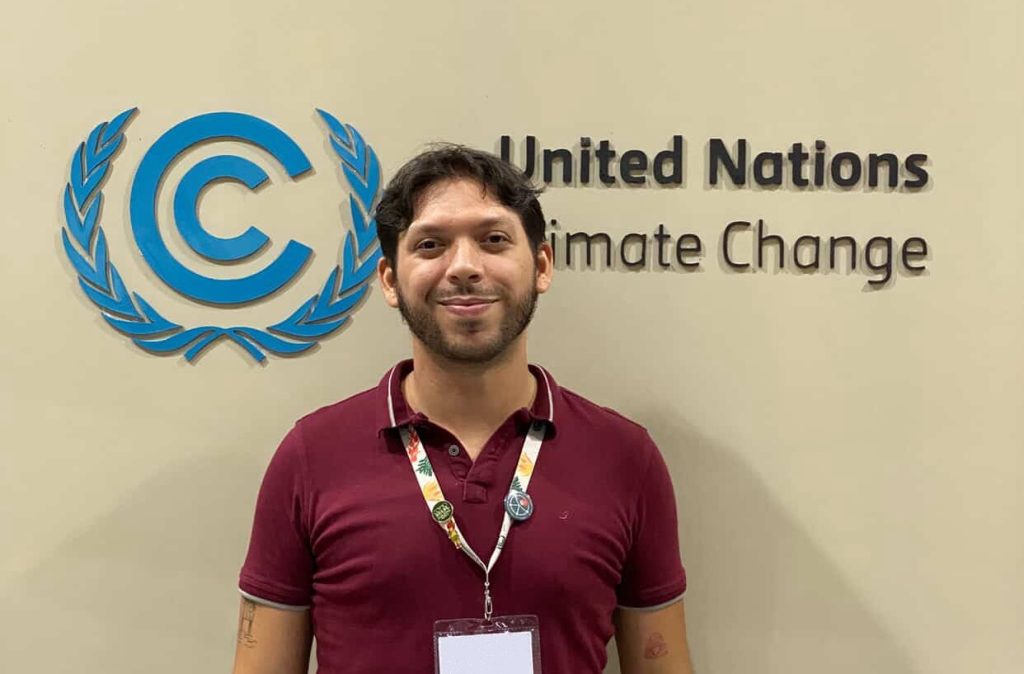
We spoke with Ruan Rodrigues, member of COJOVEM, an organisation working to empower underrepresented young people in the Amazon. Ruan shares his perspective on what it means for COP30 to take place in his home city, the longstanding inequalities shaping the region, and how the summit is influencing local visibility, identity, and representation.
Ruan Rodrigues: Hi, my name is Ruan. I’m 26, I am from Belém. I’m a member of COJOVEM which is an organization based in Belém do Pará that works to promote youth engagement, especially among underprivileged youth in the city. It has several initiatives that range from workshops and other youth empowerment activities to designing policy briefs that can be shared with government officials to increase youth wellbeing.
Zvezdana Božović: Do you also work on climate projects?
Ruan: We do! We cannot talk about youth or the future or the wellbeing of anybody, not just youth without talking about climate. Especially being in the Amazon, which is not only important to regulate the world’s climate but also because we are very vulnerable to climate change and climate disasters.
Zvezdana: The decision to host the COP in Belém has been met with mixed reactions. Some people were very supportive and theys saw the vision of the government to posit the negotiations at the heart of the issue, so at the heart of the entrance to the Amazon. On the other hand, some people have also criticized the choice of the host city as perhaps inadequate or not capable enough from an infrastructure perspective to support this event. What was your initial reaction when you heard that this flagship event for climate change was to be hosted in your city?
Ruan: I guess you could say that I’m a little biased because I am from here. At the same time, even people from here had different reactions to it. Some people were against it, and some people were very much in favor of it. For me, I knew the challenges we had because I live here. It’s not like we are trying to say we do not have any problems and that everything people are complaining about is a lie. We do have problems, and mind you, most of the visitors are only experiencing the heat, the traffic for two weeks. I’ve experienced it for 26 years so I know about it.
At the same time, if the goal and what’s so important for the conference is infrastructure and proper air conditioning and that’s more important than the actual relevance of the discussions that are happening, is the conference really doing what it’s supposed to do? At the end of the day, I do think it was the right decision. For the longest time, we had to fight a lot of prejudice and xenophobia coming even from within Brazil in the beginning. Historically, the Amazon and the northern region of Brazil have been very seriously and dramatically left outside of the great nation of Brazil.
It feels like we are a different country in a lot of ways, so it’s not the first time we are facing prejudice in Brazil. The stereotype is that the Amazon is just a big forest and there’s nothing here, and everybody who lives here are just a bunch of Indigenous people in their little communities in the middle of nowhere. None of this is new, but this year specifically we had to fight against that more than before.
Personally, I think it was a brilliant idea to host it here, not despite of the problems but even in view of the problems. I don’t expect everybody to love the city, though it’s pretty hard not to. If anything, I want folks to leave Belém knowing and aware of how tough it is to live here and to know that’s caused not only by climate change, because that’s a relatively recent thing, but also by colonialism and by the structures of injustice and power that have made the Amazon what it is today. Thousands of years ago, the Amazon used to be a very advanced civilization, but then because of colonization and because of the way that played out in the country, the Amazon was left with this position of being a colony within a colony. For the longest time, everything happened in the southeast of Brazil and the power was concentrated there. After Brazil became independent, it stayed that way. It’s one of the reasons why we have such low HDI levels. If you think about the ten cities with the lowest HDI in Brazil, they are all in the Amazon. That’s not for no reason and it’s not because the Amazon is poor or resourceless.
If anything, it’s the opposite. It’s because of power and injustice that has roots in colonialism, so I want people to come and see how it is to live in this little part of the country. It’s actually not exactly little – around 40% of Brazil is the Amazon. There is a lot of us living here, not just a few communities here and there. I am pretty sure that a lot of people who come are surprised to see that they will land in a big city with buildings. It is surrounded by the rainforest, but it is also a big city. Now, in addition to a history of neglect, we also have to deal with climate change. This is why it’s so important that these discussions happen here because for the longest time, we were left outside of everything, even decisions that were about ourselves.
Zvezdana: You mentioned this experience of exclusion from processes that concern local communities. On the second day of COP30, Indigenous activists protested and attempted to enter the venue, perhaps suggesting that they may not have had other effective avenues for their voices to be heard. In your view, has COP30 so far lived up to the expectation of being a space that includes and represents these perspectives?
Ruan: That’s a great point and I think it goes to show that there is a microcosm of problems. I would say yes to both perspectives. In the sense that bringing the COP to the Amazon is breaking a lot of paradigms and actually enabling a fundamental shift in the way these negotiations happen. I’m not saying that bringing the COP to Belém will solve every single problem regarding how exclusive of an event it is. If they are protesting, it’s not for no reason. When we walk the halls here, we do see a lot of Indigenous people, but at the same time, there could be more Indigenous people here, more youth, more underprivileged people. But the thing is, if this event happened in the south of Brazil or elsewhere in the world, these people wouldn’t even be able to fly there to protest in the first place. It’s not ideal that they are left outside, but at the same time, it’s the first time that this event is happening close enough to enable them to somehow be heard and get close. Again, it’s not ideal, but it’s the closest we have gotten.
Zvezdana: Then at the same time, a couple of days ago, the Munduruku people protested in front of the venue and the President and the CEO of COP came out and met with them. This resulted in the community securing a commitment from the government to move forward with the demarcation of their territories and to review major infrastructure projects affecting their lands, a positive outcome.
Ruan: Yes!
Zvezdana: This is only an event that lasts around two weeks. The question now is what comes after the COP. Do you think that this COP will be a catalyst for further change and progress, or do you see it more as an anomaly?
Ruan: To be brutally honest, I am torn between two possibilities. A part of me thinks that it is just an anomaly, and that after it’s done, things will go back to how they used to be with the exception of the new infrastructure around the city that we got from the conference. Maybe that will be it and that will be the legacy. At the same time, maybe even if the mode of operation doesn’t change, knowing politics, what will change, no doubt, is the way that people are starting to feel more empowered. They are starting to feel that their voices matter and that what we have to share has value. It’s the first time as an Amazonian I think that we are feeling that over here. It stems from having people hear what we have to say from our experiences with climate change and climate extremes, but also it’s the first time that we are having so many people come here and be interested in our food, in our music, you know?
I think that does something for a population that for so long has been left excluded from this place of feeling like they have a history and identity that should be valued. So I think this is what I am seeing here. As an Amazonian, it’s so beautiful and for me the most beautiful thing out of all of this is this process of seeing people from here see just how much value there is in our identity, our culture, our stories, colours and ways of understanding the world, and that there are people interested in learning about it. Even if the mode of operation of governments and companies doesn’t change, this will be the one thing that will shift.
Zvezdana: Thank you so much for taking the time to talk to me. If people want to know more about your work, where can they find you?
Ruan: People can find us on our Instagram, @cojovem.br.
Interview conducted on 19 November 2025