
#RESTalksCOP is a COP30 interview series created to bring people closer to the United Nations Framework Convention on Climate Change (UNFCCC) process. Through conversations with negotiators, experts, and civil society, we explore diverse perspectives and behind-the-scenes insights. Recorded on the ground at the 30th Conference of the Parties (COP30), these interviews offer a time-capsule look at the people and stories shaping today’s climate negotiations.
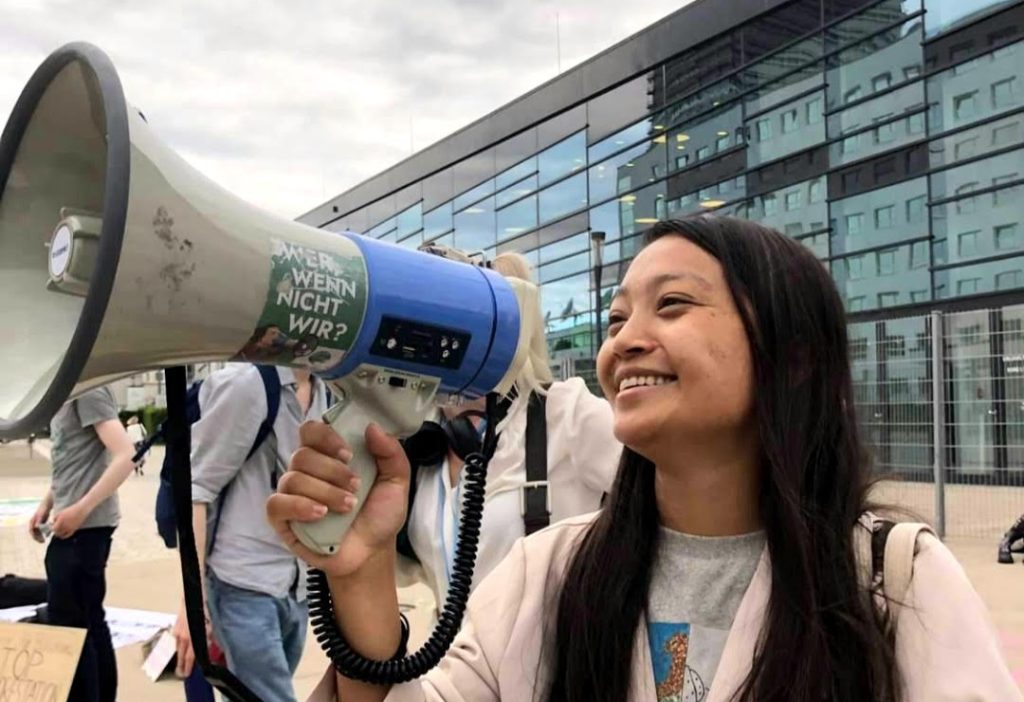
We spoke with Shreya K.C., a junior negotiator for the Least Developed Countries Group (LDCs) from Nepal, who has followed the Global Stocktake (GST) negotiations since 2021. At COP30, she reflects on the challenges of implementing the first GST, and the political complexities shaping the second cycle of the GST process.
Shreya K.C: Hi, I’m Shreya K.C. I’m from Nepal. I’ve been following the Global Stocktake negotiations since 2021. Before I was following the process with YOUNGO, the Official Children and Youth Constituency to the UNFCCC. Now I follow the process as junior negotiator for the Least Developed Countries (LDCs) Group.
Zvezdana Božović: What are you following this year?
Shreya: GST as usual, but because one item in the GST discussions intersects with finance, I’ve also been trying to follow the finance negotiations when time permits.
Zvezdana: So far, what developments have you seen this year on this agenda point? What are your impressions so far?
Shreya: Unfortunately, after Dubai where the first GST outcome was concluded at COP28, progress has been slow. Many of us pushed hard in Dubai for the final text to mention fossil fuels as no text before at a COP mentioned fossil fuels explicitly and we saw an important opportunity then. The final text used the wording “transitioning away from fossil fuels in a just, orderly and equitable manner“. It was not everything we had hoped for, but it still gave us a guiding point. The GST outcome also called for tripling of global renewable energy capacity and included points on loss and damage and reforestation which was good. After Dubai, however, we have not been able to move and we have not had any outcome on the follow-up on how we implement the GST. Now we are starting the second GST at the end of next year which complicates things.
Zvezdana: Would you say that there are any major points of agreement or disagreement between Parties or any common themes that permeate the discussions this year?
Shreya: I think there are some things that Parties agree on. For example, there are three follow-up processes after the first GST. The first is on how we can improve the second GST taking in lessons from the first one, which we also refer to as the refinement. The second is the annual Nationally Determined Contribution (NDC) Dialogue which was held at the Subsidiary Bodies’ (SBs) sessions last year and again this year. The third one comes from paragraphs 97 and 98 of the GST outcome which talks about organizing a UAE Dialogue on implementing GST outcomes. The first GST had three different phases.
One was the information collection phase that lasted 6 months, then the technical dialogue lasted 18 months, and then finally the consideration of outputs, which is the political phase, that lasted 6 months. In total it was two years, but I think one thing that most Parties agree is that 6 months for the political phase was very short and not enough. Now we need to increase the political phase duration, but that means that we would also have to reduce another process timeline. We also agreed that the technical dialogue should last 18 months because it is important that the GST is informed by science.
We are now unsure if the timeline of the latest Intergovernmental Panel on Climate Change (IPCC) reports and the GST discussions should overlap. Do we let the technical dialogue run in parallel to the political phase, or do we complete the technical phase and then move to the political phase? There are two different opinions from the LDC side. We are saying it can overlap, but a few countries in the group are saying it would be difficult because of capacity. There is not yet an agreement on this, even though we know that there has to be more time.
Another point is how we can strengthen the input to the second GST. In the first GST, especially in the technical dialogue, the thematic areas were divided into three different items. One was mitigation, then adaptation, and the last one was means of implementation and international cooperation and support. Loss and damage was under adaptation. Now Small Island Developing States (SIDS), the Independent Alliance of Latin America and the Caribbean (AILAC) and LDCs are saying we need to strengthen loss and damage, especially because the fund has now been launched.
That’s on my first point. The second point is the UAE Dialogue. We are discussing what it should focus on. That’s the point of contention. There are groups like the Like-Minded Developing Countries (LMDCs) and others who are saying that because the paragraph where the dialogue comes from is under the finance area, this dialogue should only focus on finance. But others are saying that it should focus on all elements of the GST, including mitigation, because we need to reduce emissions and focus on adaptation as well because we are already feeling the impacts. We are saying maybe we should also focus on means of implementation, including finance, capacity building, technology development and transfer.
Zvezdana: What does the timeline look like now for the process?
Shreya: On the timeline, we start the GST next year, so 2026. We will conclude it by the end of 2028, so we have 2 years. The problem is that we know that the GST has to be informed by the latest best available science, and this we normally consider to be synthesis reports of the IPCC. However, the timeline of the IPCC and the GST doesn’t match. One group of Parties, we are saying that we need to invite the IPCC to align their report timeline with the GST if possible so that the overall synthesis report is released by 2028. Some other groups are saying that we cannot reduce the timeline of the IPCC because it is a scientific body which has to do rigorous scientific assessment. If we reduce the time, then it would puncture the credibility of the IPCC and its scientific findings. So we are discussing now what could be an alternative.
On the NDC Dialogue, we had it in the last SBs where Parties shared about challenges, opportunities and barriers to preparing NDCs. There is a summary report prepared by the Secretariat, but there are groups like us that are saying the report from this dialogue should produce something substantial, meaning that it should provide guidance to the next GST how we are preparing NDCs. There are other groups saying that this is just a dialogue where we summarise key findings and just leave it at that. These are the main points, but we are having the same discussions again and again and we need an outcome by now.
Zvezdana: At the very beginning, you’ve touched upon finance and how it is integrated into the GST. My impression from speaking to many people so far has been that finance is really an underlying theme to everything that we discuss this year. How do you see finance affecting the GST in its second round?
Shreya: That’s an important question.
The aim was that the GST outcome would inform the next round of NDCs. Last year in Baku we had the decision on the the New Collective Quantified Goal on Climate Finance (NCQG) where developing countries were asking for at least 1.3 trillion per year, and the final outcome was just something like 300 billion per year with a call to scale up to 1.3 trillion. It also has to come from all sources, not just public finance of developed countries, but also from the private sector, and from developing countries. This affected Parties’ trust in the NDCs. Even if we prepare an ambitious NDC, if there is no finance, we cannot implement it, so we can’t waste time updating them. I think this was the kind of impression that left, which is dangerous.
Parties had to submit their updated NDCs by February this year, but very few did. Then it was extended to September when the UN General Assembly was happening and even by that time, not all countries submitted their NDCs. Finance is key because without it, we cannot implement the NDCs. Almost 80% of NDCs include conditional targets which then could not be implemented. Even if we are preparing new NDCs, we are not reducing the emissions which in turn increase the temperature. In Baku for example, the COP29 Presidency initially placed the UAE Dialogue under ‘Matters Relating to Finance’ rather than under the GST. Many Parties did not agree to this, and that’s why we could not start the opening plenary as supposed to. After long discussions, Parties agreed to treat the placement as a placeholder and won’t guide the discussions. It’s safe to say finance has been pretty contentious.
Zvezdana: Outside of the negotiations, are there any projects you are working on that you would like to spotlight?
Shreya: (laughs) It’s difficult to think about the outside of the negotiations when we’re fully immersed in what’s happening right now. In Nepal I work with an organization called Clean Energy Nepal. We work on climate change with youth. One of the main focuses of our work is air pollution. South Asian cities are hotspots of air pollution. We often rank at the top of the most polluted cities in the world. With winter season approaching in Nepal, India, Pakistan, the neighbouring countries, air pollution has become a big problem now. Pollutant levels are 10 times higher than the guidance of the World Health Organization (WHO). We are installing air quality sensors in all parts of Nepal to collect data and to use that data for policy advocacy. Air pollution also connects to climate change, so I think we are doing important work that makes an impact.
Zvezdana: Thank you so much for taking the time to talk to me, if people want to know more about you or your work, where can they find you?
Shreya: I’m available on LinkedIn, Shreya K.C., and Instagram, kcshreya1.
Interview conducted on 18 November 2025