
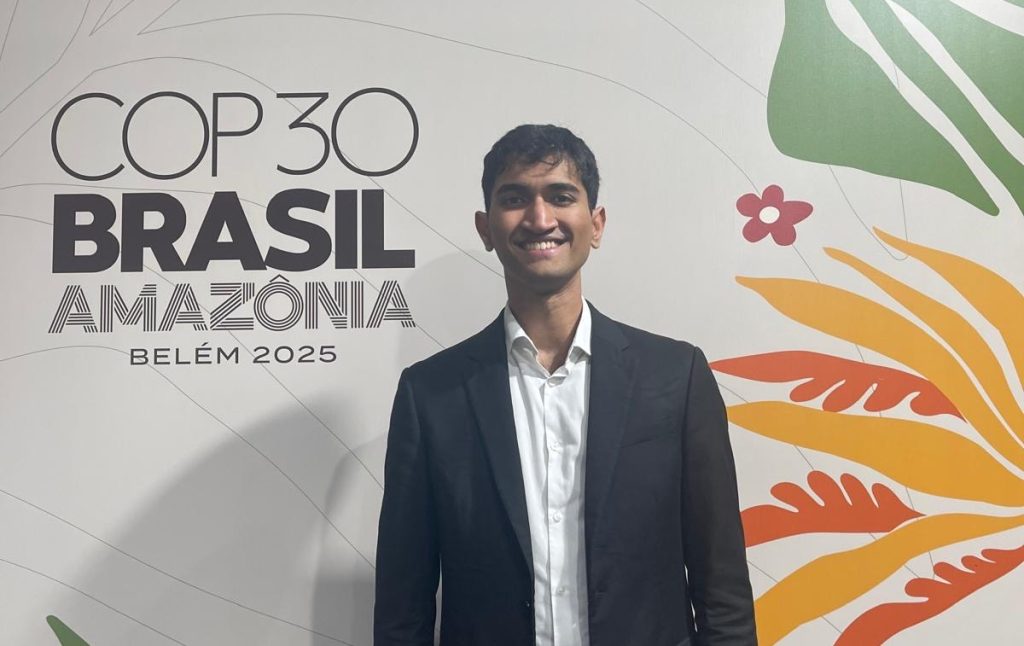
#RESTalksCOP is a COP30 interview series created to bring people closer to the United Nations Framework Convention on Climate Change (UNFCCC) process. Through conversations with negotiators, experts, and civil society, we explore diverse perspectives and behind-the-scenes insights. Recorded on the ground at the 30th Conference of the Parties (COP30), these interviews offer a time-capsule look at the people and stories shaping today’s climate negotiations.
We spoke with Vivek Venkatram, a Master of Public Administration Fellow at Columbia University focusing on climate, energy, and food systems, and advocate working with Generation Climate Europe and ProVeg International. At COP30, Vivek advocated for sustainable and climate-resilient food systems. In this conversation, he reflects on missed opportunities, the influence of agribusiness lobbying, and why food systems remain sidelined in climate negotiations despite their central role in mitigation, adaptation, and biodiversity.
Vivek Venkatram: Hi, I’m Vivek. I’m doing my Master’s of Public Administration Fellowship at Columbia University, concentrating in Climate, Energy, and Environment, and focusing on food systems.
Zvezdana Božović: How long have you been involved in the UNFCCC process?
Vivek: I first got involved in the UNFCCC process two years ago, during my internship looking at public finance flows for water and sanitation projects, and seeing how the pharmaceutical and agriculture company I was working at could engage in social impact work through the UNFCCC process. From then on, specific to working in this space, I was selected to join the Generation Climate Europe Partnership Team for COP29, where I worked on advocacy within the European Union to ensure that the EU fulfills its commitments on the New Collective Quantified Goal on Climate Finance (NCQG), particularly around the nature of the quantum and the size of the quantum that was proposed.
Last year, I was also with UNESCO, working on promoting their Global Education Monitoring Report. That work focused on bridging the ties between climate education and climate finance, especially given that only 0.001% of climate finance goes into climate education.
Zvezdana: What are you following at the COP this year?
Vivek: At this COP, I’ve been with Generation Climate Europe and ProVeg International, focusing on directing more climate finance into sustainable food systems and getting that higher up on the agenda. I’ve been following the Sharm el-Sheikh Joint Work (SSJW) work stream, the Just Transition Dialogue, and the Mutirão text.
Zvezdana: What are your impressions this year?
Vivek: Overall, I’m a bit disappointed with how things have gone, but I also feel inspired by many of the advocates here and the action projects taking place, specifically the Presidency Action Agenda. It’s obviously very positive that we saw the The Belém Action Plan (BAM) come through, the action mechanism for the Just Transition text. This was something that civil society, especially CAN, had spearheaded and really pushed for, to allow for grant-based climate finance and non-debt-inducing finance for Just Transition, as well as capacity building across countries. Specifically, I think that’s what the BAM helped us get. That was the main win we achieved.
Zvezdana: BAM seems to be one of the main outcomes celebrated as a success. On the other side of the spectrum, many are really disheartened about the exclusion of text addressing fossil fuels.
Vivek: Yes. I’m quite disappointed that we did not manage to achieve a roadmap on fossil fuel phase-out, as well as on the biodiversity roadmap. I think a lot more work can be done on both of those points outside of the COP. The delegations of Colombia and the Netherlands have done a lot of good work in that sense, including through a conference they’ll be hosting, I believe, in March.
Zvezdana: You have mentioned that one of your specializations is in food systems. How have food systems been addressed this year at the COP?
Vivek: Specific to food systems, the Sharm el-Sheikh Joint Work negotiations were delayed to Bonn, so we didn’t really see anything concrete in week one of the COP, which was what many of us were hoping for. Then in week two, under the Just Transition discussions, there was a mention of climate-resilient food production. However, due to some Parties not accepting that wording, it was removed from the final text.
My intention was to bring forward sustainable food production and climate-resilient food production in Clause 12(f) of the Just Transition text. However, there was an unwillingness among Parties to move beyond food security into wording tied to adaptation, let alone mitigation. That sustainable food wording was simply not on the table at all. Even within the Mutirão text, there was no mention of food systems. I was working within YOUNGO and also within the European Youth Delegation to bring this forward. Unfortunately, we couldn’t get it through because much of the dialogue here at the COP focused on biofuels, trying to get them into the text.
I’m very glad that we were able to push back against this, and at least ensure that there were no negative or distracting references to food systems included in the text. So although we didn’t achieve much positively, at least we prevented further backsliding on food systems.
Zvezdana: Many who work on agrifood systems appear to share the sentiment that food is still not getting the attention it merits in this process. From your perspective, what efforts have emerged at COP30 to elevate food systems in the negotiations, and what kinds of solutions are being proposed?
Vivek: I want to highlight the Belém Declaration on plant-rich diets and key youth demands for plant-rich diets, which were highlighted here at COP by ProVeg, along with colleagues across ministries, for example in Denmark and with MEP Lina Schilling and a few other Members of the European Parliament who signed on.
What this is calling for is for governments to incentivize and promote plant-rich diets, especially in the Global North. This is what we’ve been working on at the ProVeg UN Youth Board, through key youth demands for plant-rich diets and food systems, to encourage countries in the Global North to shift toward plant-rich diets for sustainability, particularly for mitigation, reducing environmental degradation, and biodiversity loss.
For example, around 80% of deforestation in the Amazon is linked to cattle ranching, and approximately 76% of global soy production is used for animal feed. Health is another important angle, and that also ties into food security. It currently takes around 25 calories of input to produce one calorie of beef, and around 9 to 1 for chicken.
Zvezdana: Throughout the negotiations, there has been growing attention on the role of lobbying and power dynamics within the COP space. Do you see this playing out in the food sphere as well, and if so, how?
Vivek: I think this is exactly why engaging in key youth demands is so important. Here at COP, we’ve seen the presence of around 300 big agribusiness lobbyists. According to a report published by DeSmog, which was also covered by The Guardian and Forbes, this influence is significant.
That’s why it’s really important to center the voices that are often neglected, those of Indigenous youth, Indigenous communities, youth representatives, and other marginalized groups. That’s the intention behind the key demands on plant-rich food systems. And alongside the massive number of fossil fuel lobbyists we’ve seen at COP, we also shouldn’t lose sight of the influence of big agribusiness, particularly big meat and dairy, in shaping these negotiations and acting as a barrier to progress.
Zvezdana: Now that this COP is over, do you have any particular expectations or hopes for next year and COP31?
Vivek: I’m hopeful for more unity among youth and across different groups to speak out against efforts to derail progress after climate summits. I also hope food systems will be higher on the agenda, especially as we move toward closing the Sharm el-Sheikh Joint Work at COP31. I’m cautiously optimistic, but hopeful that things will improve.
Zvezdana: Thank you so much for taking the time to talk to me! If people want to find out more about your work, where can they find you?
Vivek: Thank you for inviting me! I can be found on LinkedIn as Vivek Venkatram and on Instagram @vivvenkatram.
Interview conducted on 24 November 2025