
#RESTalksCOP is a COP30 interview series created to bring people closer to the United Nations Framework Convention on Climate Change (UNFCCC) process. Through conversations with negotiators, experts, and civil society, we explore diverse perspectives and behind-the-scenes insights. Recorded on the ground at the 30th Conference of the Parties (COP30), these interviews offer a time-capsule look at the people and stories shaping today’s climate negotiations.
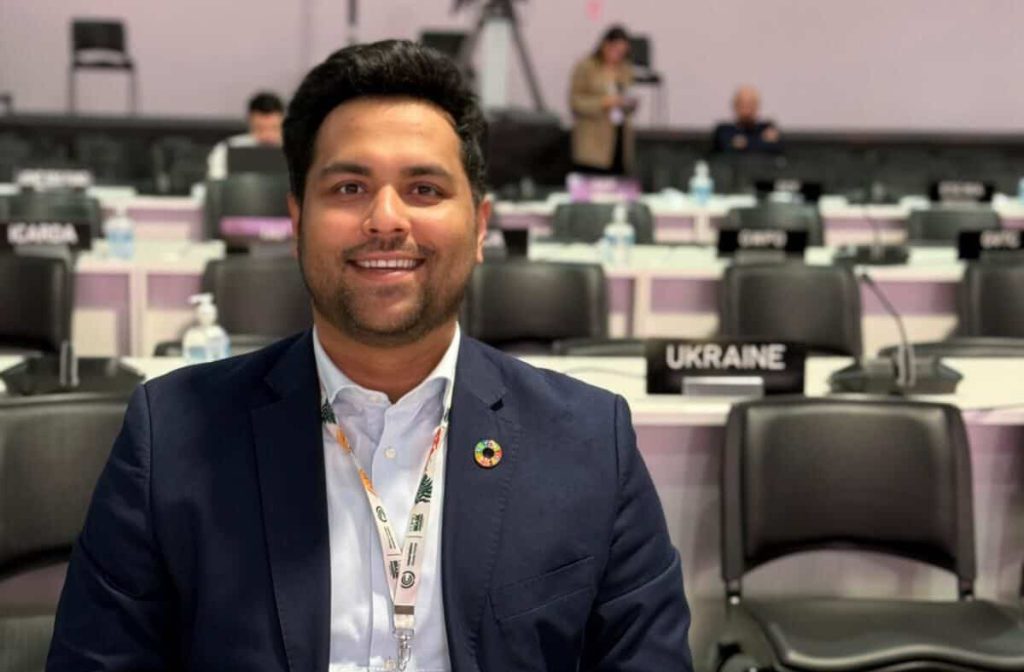
We spoke with Neeshad Shafi, a policy and advocacy expert from Qatar. Recognized by The Independent’s Climate100 list of most influential people in climate policy, Neeshad works on Article 6 of the Paris Agreement with a focus on carbon markets and public–private partnerships. In this conversation, he discusses the evolving landscape of market mechanisms, the role of private finance in the transition, and the importance of aligning government ambition with private-sector action.
Neeshad Shafi: Hi, I’m Neeshad Shafi. I work on advocacy, policy, and I am also now working on Article 6 of the Paris Agreement, following Articles 6.2 and 6.4. My interests are around carbon markets and compliance.
Zvezdana Božović: How long have you been engaged in the UNFCCC process?
Neeshad: Since Paris, so COP21.
Zvezdana: What have your impressions been so far on the progress in negotiations on these agenda points?
Neeshad: As you all might know, Article 6 was approved at COP29 in Azerbaijan. Now it is in its implementation phase, but Article 6.4 is still under discussion because countries are working on finalizing methodologies and standards. On 6.2, countries are already engaged on Internationally Transferred Mitigation Outcomes (ITMOs). That means carbon trading between states which is a good, positive start. Some of the countries who are leading this are Switzerland, Singapore, and Sweden, along with a couple of other European countries who are mostly looking at buying credits from developing countries. At the moment, most countries are also developing their own carbon market system on national level, because that’s crucial to having a transparent carbon market ecosystem. Otherwise, it will fall to the same old carbon market issues around greenwashing etc. So it is very important to have a transparent mechanism to make sure that what is done under the carbon markets is in a right and just manner.
Zvezdana: That brings me to just transition and the general topic of how to make the future more equitable? So what would you say are the main obstacles to this right now?
Neeshad: The main obstacle is finance. How do you get finance to those projects? Therein lies the bigger role of the private sector. These people are much ignored, thinking that the funding for the transition will come from governments. That’s a false dream. Governments will not fund the transition, it will be the private sector. At the end of the day, the private sector is creating enormous amounts of wealth in the market, regardless of whether they are a polluter or non-polluter. People keep asking, demanding from their governments, but I don’t see people talking to the private sector. That’s where the money is, so I think finance is a big hurdle.
Zvezdana: How do you see the role of the private sector in the just transition?
Neeshad: People have to look at the private sector to invest in a great portion of this transition. If we look at it from the perspective of Article 6.2 or 6.4, the compliance market is very much aligned with the role the private sector can play where they invest in projects and get returns. The private sector only looks at investments where there is return. They don’t do charity. Any private sector actor would be attracted to implement projects around nature-based solutions, which are a form of carbon removal, or climate projects if they can get a good ROI. It can be natural carbon removal, or technology-based carbon removals like carbon capture and storage (CCS). It’s sometimes claimed as a false solution, but IPCC has reported net zero is impossible without carbon removal.
It comes to the point where most of the negotiations are linked to who finances the transition. I think for me, my personal opinion is that the private sector should also be there at the table to make sure that governments align with how the private sector is looking on climate and finance. Private sector looks at ROI, whereas the government wants to make sure that the investment goes to the people, to the community, and that at the same time, it’s not going to the oil and gas sector, but more to renewable energy. There is a win-win scenario, but personally, I see a gap in the non-alignment of the private sector with government targets. That is something I would hope from COP30 to deliver is that governments are more aligned with private sector’s ambition and to ensure they bring the funds to the table.
Zvezdana: When we talk about engaging with the private sector, I think what I have also noticed is that there seems to be a reluctance to approach the private sector, and there seems to also be a disconnect in the language that is used. How do we bridge this gap? How do we translate the tangibility of a certain climate project that may not appear at first glance as profitable?
Neeshad: That’s where the government drops the ball. They primarily look at the people angle, they talk about people and community, not knowing they’re investing in people and community as a returns also. For example, I work in carbon markets. If a company invests in a renewable energy project, it brings free energy access to them, right? You can bring the price of renewable energy down to almost 1 dollar. That is something that also helps with emission reduction and meeting nationally determined contribution (NDC) targets. Carbon markets include nature-based solutions, do they not? There’s a huge space where nature-based solutions and biodiversity enhancement create jobs for communities and help communities in regions which have experienced a lot of deforestation happening over the years.
We always say “community first”, not knowing that the private sector does not like that language. That’s the disconnect between the private sector and the government here. If governments were to speak the language of the private sector, explaining how investments will have returns, but also making sure that investments go to community, nature, and emissions reductions, this is how the gap can be bridged. The language can be made simple by having stakeholder discussions, mostly around how to align and identify which sectors they want to invest in. Is it renewables? Is it nature-based solutions?
Governments need to be very specific on what they ask for. At the moment, private sector is in its own world, governments keeps using political language and nice slogans, which are nice to hear at a conference. However, what is happening as we go back to the ground realities is not that. If you look at numbers, emissions are going up, the governments are also flawed at some point, but recently, the EU also came up with an approved plan for what they want to do for their 2040 emissions target.
The same goes for some Middle East countries, they have net zero targets. They are working on getting their targets met in a way that is only technology-based, but the technology is developed to an extent that we can use it to reach 2030, 2040, 2050 targets now. For the moment, my opinion is to tax the polluters. It’s a way to make oil and gas industries move away from fossil fuels, and at the same time be taxed for whatever emissions they produce.
Zvezdana: When it comes to public-private partnerships right now, which sectors do you see as pioneers in the field?
Neeshad: Renewable energy is a good example to share. It’s really a win-win situation – ROI for the private sector, governments can add that it to their NDCs showing what their emission reduction is for the 2030 target. So renewable energy is a perfect example, and recently you have seen reports from Africa showing that renewable energy almost beat fossil fuel energy. Governments cannot do it alone without private-sector money. So I feel that the whole renewable energy example is quite a good one to show that it could be replicated in other sectors too.
Zvezdana: Do you think the UNFCCC process as it is set up now is fit to address these issues and to foster and serve as a forum for public-private partnerships?
Neeshad: It is a forum, I think. COPs are the forum, but we should work after the COPs too. Most of the time, the private sector has many more engagements beyond the COP. Even at the COP, beyond oil and gas obviously, other sectors are not very well represented. As a result, other sectors often don’t understand the COP language. I think engagement is key. It’s the job of every government going back home and engage with the private sector to see how much they can finance renewables and make sure that oil and gas are the first ones to be taxed. I think there is still a big gap there in general, though it’s also case-to-case, country-to-country.
Zvezdana: So we are only on day 4 now, it’s still quite early to tell what the outcome will be, but what is your general feeling about the COP this year? Would you say that you are optimistic or cautious?
Neeshad: A couple of areas are still very unclear. I don’t think anything happened in day 1. In some of the tracks that I am following about Article 6 and the Global Stocktake (GST), there are a lot of large jumps. Countries are going back. Some of the countries have been very sarcastic around some of the text. They don’t want to add the oil and gas sector in just transition. They want to make sure who finances it. It’s always the same. I normally don’t see much updates on COP week one. It’s always week two. That’s why most of the time, you see COP get extended to a day or so because it is always off to a slow start. But I think my good takeaway for COP30 would be some advancements around GST, just transition and financing loss and damage. These are the key sectors I think would have some good results coming out of the COP.
Zvezdana: What are you working on now?
Neeshad: I am working on a rice cultivation project in Cambodia. As you might now, rice cultivation emits methane. Methane is one of the great potent greenhouse gases (GHGs). What we do is invest in projects which reduce CO2 and any GHG emissions. This project in Cambodia creates jobs for a lot of farmers. It uses techniques which reduce methane emissions, in a way that helps people and strengthens food security, helps job creation and helps Cambodia’s methane reduction. It’s a win for nature, reducing methane, job creation and food security!
Zvezdana: That sounds amazing! Thank you so much for taking the time to talk to me. If people want to know more about your work, where can they find you?
Neeshad: They can find me on LinkedIn or other social media with the same name.
Interview conducted on 13 November 2025