
#RESTalksCOP is a COP30 interview series created to bring people closer to the United Nations Framework Convention on Climate Change (UNFCCC) process. Through conversations with negotiators, experts, and civil society, we explore diverse perspectives and behind-the-scenes insights. Recorded on the ground at the 30th Conference of the Parties (COP30), these interviews offer a time-capsule look at the people and stories shaping today’s climate negotiations.
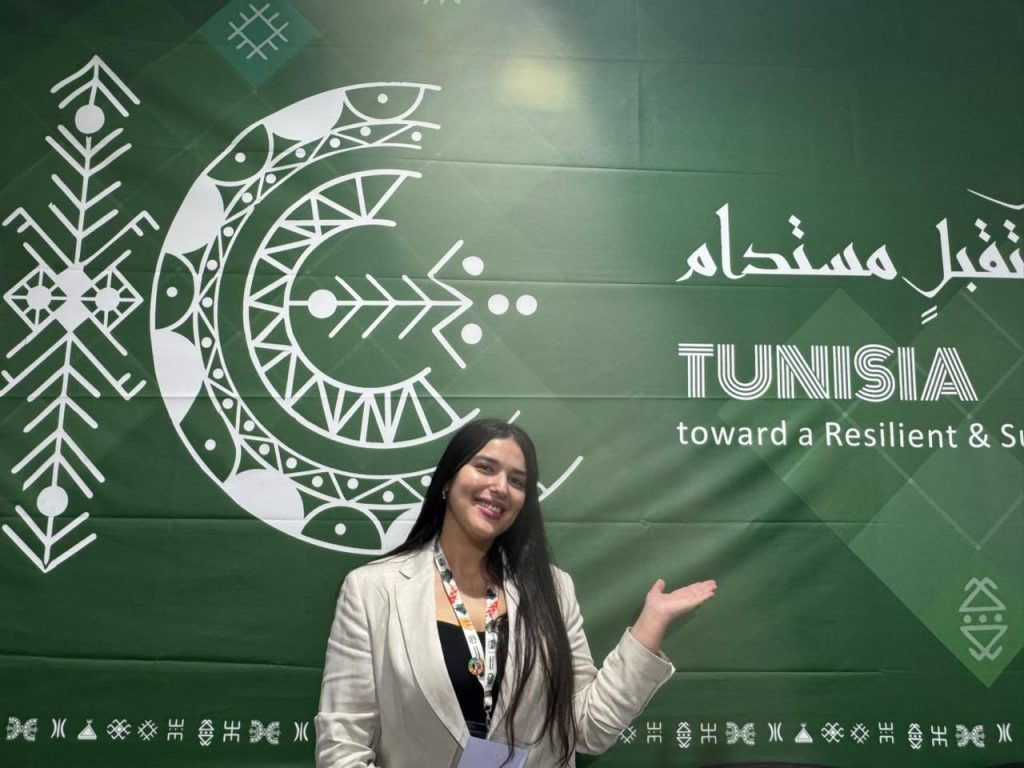
We spoke with Nouha Salhi, a youth negotiator from Tunisia following the technology track at COP30. Nouha shares her perspectives on technology transfer, capacity-building, and the political challenges shaping progress under the UNFCCC technology mechanism.
Nouha Salhi: I’m Nouha Salhi. I’m from Tunisia, and I am a youth negotiator following the technology track this year at COP30.
Zvezdana Božović: How long have you been involved in the UNFCCC process?
Nouha: This is my third participation in COP and I also participated in three Meetings of the Subsidiary Bodies (SBs). My first one was SB58. I started following just transition back then, but now shifted to the technology topic.
Zvezdana: And outside of the negotiations, what is your background?
Nouha: My background is in business administration, but I also studied diplomacy, more specifically related to economic diplomacy topics.
Zvezdana: So this year at the COP, you mentioned you are following technology? Can you tell me more about it?
Nouha: This year, I am following technology transfer. This has two subsections, which are the technology implementation plan and the review for Climate Technology Centre and Network.
Zvezdana: What developments have you noticed in the negotiations and have there been any common themes or points of consensus or disagreement among the Parties on this particular agenda point?
Nouha: I have honestly not been very positive on what the developments have been so far. There is a big divide within the room, and this is mostly related to the scope and mandate itself for the implementation plan. So there have been questions on whether the network for technology is supposed to cover the technological capacity-building and technological transfer costs, and also there have been discussions yesterday in the room which were related to the actual listing of technologies and what is a technological transfer. Is it new technology or working on already existing technologies within the scope? The questions are more related to the financing aspects of who finances what. Is it under the UNFCCC Secretariat’s mandate, or is it within the network itself? These are, I would say, the questions right now.
Zvezdana: From your perspective, what would you single out as the main obstacles to achieving a more equitable and just outcome for the negotiations on this point?
Nouha: I think the biggest point here is related to the interests of different Parties and having to think in a collective way without also costing any Party to lose face in a way. That is, I think, the biggest blockage. There have also been questions related to including the Global Stocktake (GST) outcomes and also working towards the next GST. I think the trouble is more related to who bears which cost and how to not lose face while finding differences and progressing with negotiations.
Zvezdana: Sort of like a prisoner’s dilemma?
Nouha: Unfortunately, yes. (laughs)
Zvezdana: When it comes to tying the technology mechanism to the second GST, what are your hopes for the second round?
Nouha: My aspiration is to have a more concrete plan that takes into account the needs of the most vulnerable, but not only the most vulnerable. Because when we talk about technology and technology transfer, there has been a lot of not positive usage of technology, I would say. There is also some economic interest in the aspect related to that, and we want it to be serving climate justice, not just technology as for technological progress and also economic opportunities, market opportunities, but to make the scope of UNFCCC negotiations more centered on ensuring justice through capacity-building.
Zvezdana: From a bloc perspective, as you are also part of the African group, have you noticed any obstacles in the group as a whole to achieving your goals in the negotiations? Is there anything you wish to have in place that is missing now to be more efficient as a group?
Nouha: Well, I think Africa is diverse. That’s always the question. But at the same time, I feel that the need for technology is a common need and that is something that the continent as a whole is more or less on the same page on. In my perspective, there is a lot of work, a lot of potential and work happening on technological aspects, especially related to agriculture or disaster risk reduction (DRR). Yesterday, there was also a mention of solar radiation modification (SRM). Not in the negotiation room, but in a separate event. There is big potential for that and I think Africa is on the lead when it comes to these kinds of topics.
Zvezdana: There seem to be differing opinions in the UNFCCC space on what role technology should play and on its significance. Whether we should turn more to, let’s say, nature-based solutions and traditional knowledge or if we should really turn to technological innovation. Obviously, both things can be true and exist at the same time, but what is your perspective on this?
Nouha: Yes, I don’t think these are two different realities. I think it’s very complementary, because we do need the know-how from indigenous communities and more traditional settings. I think that absolutely has to be continuous because we cannot only rely on technology, like for example AI. Another topic is also misinformation, which is very connected to technology. We need to keep things humane, keep them always related or centered on traditional know-how and nature.
I would also add, related to agriculture, specifically on water technologies – we can never replace the indigenous know-how, but technology and innovation are complementary because it can take it to the next level, to have access to more up-to-date data tracking, supply chain-related innovations that also help us track our emissions, track our transition. I would say it’s one reality, not separate ones.
Zvezdana: So technology should really be rooted in the local context and in the traditional knowledge that already exists.
Nouha: Exactly. It should always be adapted to the local context and can never be transposed. A copy-paste model never works.
Zvezdana: This COP has been dubbed the “COP of Truth”. In the past, other COPs held more concrete themes like the “COP of Finance”. How do you interpret this?
Nouha: For me, “COP of Truth” means stopping these generic messages, generic truths because I think we all have the responsibility here to really speak out our truth and not just be there, representing, taking the mic, just to say what has been said times and times again. We have to speak from the heart and speak also from the realities that we do live in. I think Belem as a location is already demystifying whatever realities have been created throughout the centuries. But now, this is COP30, we are back to Brazil after thirty years and we have to speak with more honesty and also put the finger on the realities that hurt. That is for me the “COP of Truth”.
Zvezdana: It is also ten years from Paris, so it’s quite a landmark conference.
Nouha: Exactly. After ten years from Paris and two years from the last Global Stocktake, we are at a point where we have to do things differently because the old ways are not an option.
Zvezdana: Thank you so much for taking the time to share your insights, I really appreciate it. Is there any project that you are part of that you would like to spotlight?
Nouha: I would maybe also refer to the initiative I am part of. So I am here as part of the national delegation and within our delegation, we have a youth negotiator group, so we are officially representing our country as negotiators, and even as lead negotiators on thematic areas. I think this is a very nice example coming from my country, my continent and my region. I think this should be duplicated in other countries and organizations. We, as youth, are feeling the sense of urgency. We know this is not a topic of tomorrow. This is a topic of today. We know our generation, next generations, will be suffering or are already suffering. People are already on the move because of climate change. This is a topic I also want to highlight. Climate mobility has to go through in the negotiation rooms. It is already a topic within Adaptation and Loss and Damage for instance, but we need to see this also be part of more negotiation rooms.
Zvezdana: Thank you so much! If people want to know more about your work, where can they find you?
Nouha: If people want to know more about my work, they can find me on LinkedIn and on Instagram, as Nouha Salhi. Thank you.
Interview conducted on 18 November 2025