Author: Perun Prodanović
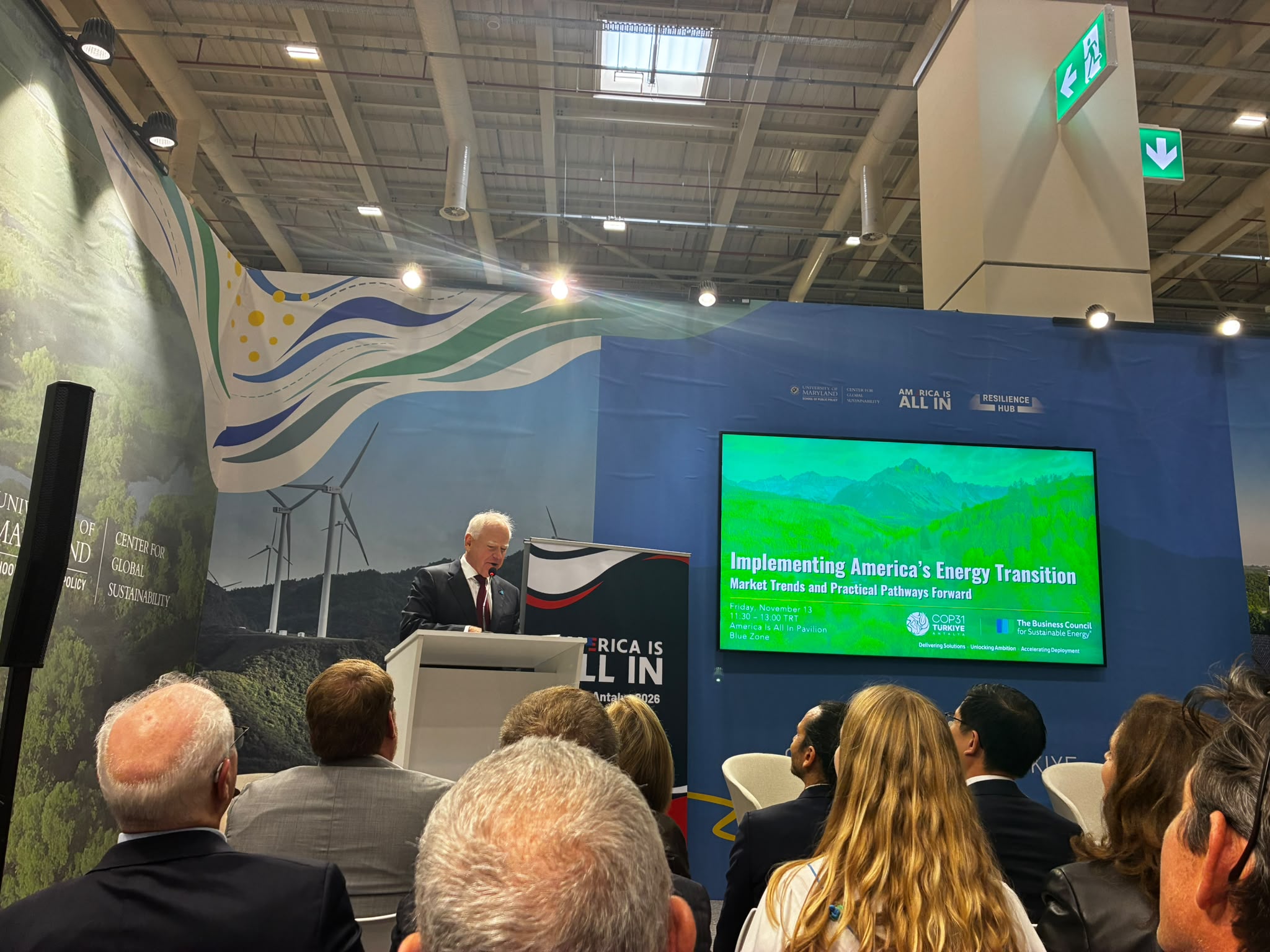
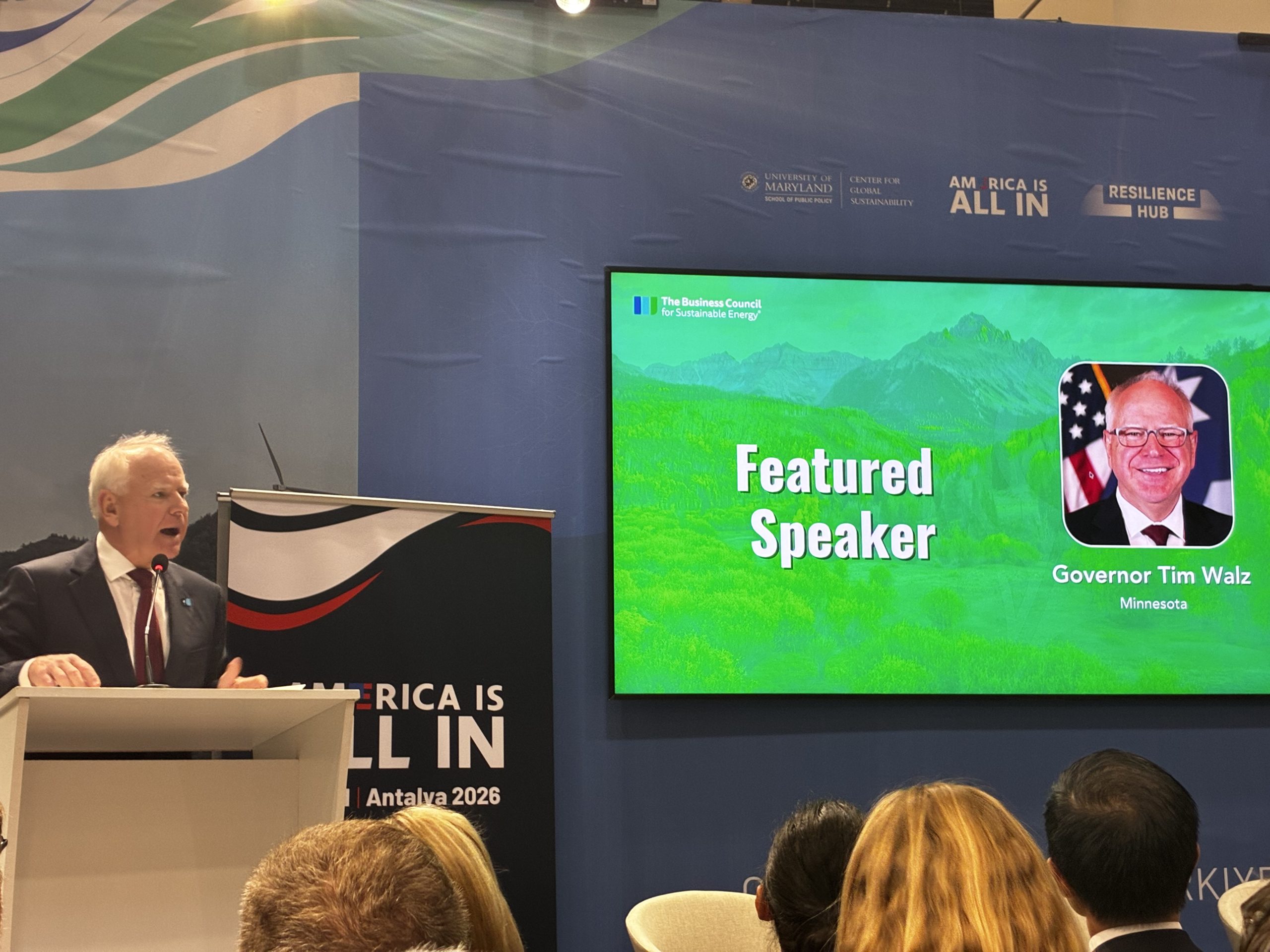
On Friday, November 13, 2026, Day 4 of COP 31 in Antalya, Türkiye, the America Is All In Pavilion hosted “Implementing America’s Energy Transition: Market Trends and Practical Pathways Forward,” a session running from 11:30 to 13:00 and presented by the Business Council for Sustainable Energy. The session was the most interesting to date and it was framed around a simple question: with America’s rising energy needs putting investment decisions in the spotlight, how are US businesses responding, and how can public-private partnerships deliver the infrastructure that communities need? It was designed to give an overview of the US energy economy and to bring corporate leaders into conversation with public officials on moving projects forward. The programme featured State Governor of Minnesota Tim Walz, Bob Hinkle of Metrus Energy, Katie McGinty of Johnson Controls, Matthew Satterwhite of National Grid, Lisa Jacobson of the Business Council for Sustainable Energy, and the mayors of Boulder, Colorado (Aaron Brockett) and West Sacramento, California (Martha Guerrero). This report concentrates on the opening market presentation by Albert Cheung of BloombergNEF (BNEF), titled “US, Global & Energy Market Trends,” which gave the data for the rest of the discussion.
Cheung began with the global picture, showing a chart of energy transition investment that has risen from roughly 60 billion dollars in 2005 to around 2.4 trillion dollars in 2025. Against that growth he set a note of caution about energy risk, pointing to the disruption linked to the Strait of Hormuz. He stated plainly that he does not know when markets will return to normality. A further chart on oil prices suggested that conditions are likely to get worse before they get better, with the outcome depending heavily on how long the disruption in the strait lasts.
He then turned to what the conflict has meant for clean energy trade. A chart of monthly exports of Chinese-made clean energy goods showed them climbing to about 21 billion dollars per month, and Cheung argued that the war has created a step change in demand for these goods. The next chart showed global deployment of renewables and storage continuing to grow. All of humankind installed roughly one terawatt up to 2017, he noted, whereas 2026 alone will add one terawatt, and the projection is for further growth beyond that.
From deployment he moved to electrification, which he described as changing the shape of the energy economy, using two charts. The first compared countries by electric vehicle numbers, with China far in the lead and accounting for around 70 percent this year. The second looked at electricity’s share of final energy and indicated that electricity could overtake oil around 2037. A third chart linked these trends to demand, showing a very large increase in the amount of power the world will need in the years that follow.
From this point Cheung’s presentation focused on the United States. He showed that power demand from data centres is expected to double from today’s level by 2030. A related chart showed a large increase in on-site gas generation projects for data centres, about half of which do not disclose their suppliers. At the same time, he showed that the US is set to reach a record for clean energy this year, which he attributed to the growth of data centres and described as an encouraging sign for the future.
Storage and manufacturing featured next. Cheung presented a projected boom in energy storage, growing by 34 percent over the next ten years, and a chart of domestic battery cell production rising from 54 gigawatt-hours in 2026 to a projected 130 gigawatt-hours in 2030, in order to meet that demand. Looking further ahead, he said US power demand is expected to rise by 75 percent by 2050, from around 4,000 terawatt-hours to 7,000, led by data centres and electric vehicles. He also noted that US carbon dioxide emissions, which had fallen consistently before, are not dropping under the Trump administration and are well short of the trajectory implied by the Paris Agreement.
On the political outlook, Cheung observed that the recent large Democratic win means more state-level control over energy policy can be expected. He closed with a chart showing countries by net energy imports as a share of domestic energy consumption, on which the United States sits in the middle. In his view this leaves the country in a very fortunate position, able to choose whether it becomes an energy importer or an energy exporter. Taken together, the presentation set out a consistent argument: energy security concerns and rapid growth in demand, rather than climate policy alone, are driving investment in clean energy, electrification and storage worldwide. In the United States the central driver is the data centre, which at once pushes up demand, sustains on-site gas generation and supports record clean energy additions. The data also point to a gap between market momentum and policy outcomes, since emissions are not falling even as deployment hits records. With state governments expected to hold greater influence and the country not locked into either an importer or an exporter position, the session’s central message was that the direction of US energy markets remains open and will depend on the choices made over investment, infrastructure and policy in the coming years.
Photo credits: Perun Prodanović and Marko Macura