
Author: Marko Macura
“The future of our planet cannot be negotiated on the terms of those who profit from its destruction,” said the UN Secretary General today in his last address in Antalya. Mr. Guterres said this less than 24 hours after the news that companies dealing with fossil fuels in the ISDS (investor-state dispute settlements) courts demanded from the states over 443 billion dollars. This amount has been made public, and it is assumed that it is only a third of the total sum. In a sphere actively concerned with raising money for sustainable ways of doing business, this news sounds counterintuitive. Today, a group of people wearing chef’s hats protested near the entrance to the complex and demanded the cancellation of the national debts of smaller countries, as one way of combating climate change.
Every day so far, a large part of the pavilion at any given time has been dealing with the topics of fundraising for the next actions. As today was a day dedicated to finance and trade, we will look back at what we have heard in the past few days on this topic. This morning, a representative of the Estonian Conference of Cities and Municipalities spoke in the Estonian pavilion. He spoke about the distribution of funds allocated by the EU to this country and all its local governments. This organization works on the principle of giving projects to the richest self-governments, and if that project succeeds, then smaller self-governments know that they can enter into that project without risk. Every two years, the municipality and the president change, and this ensures focus on different parts of the country. The representative of this organization pointed out that the EU allocates large sums of money for Estonia and that they are used wisely, but that there is too much money and that they are aware that they have relatively fewer problems than other countries in the world.
On the second day, we listened to a representative of the Spanish BBVA that pointed out that he simply could not find a direct interested party that would allow them to return the investment. In question was a project by the Basque region to relocate an entire neighborhood that was on the verge of flooding due to sea level rise. He mentioned that he understands that people will benefit and that various businesses will benefit, but that there is no guarantee that this money will be invested wisely. As a good example of investment, he mentioned the highway that his bank partially finances in Turkey and that the climate action plan is directly part of the project, so money will be automatically allocated to those mitigation measures. A few days later, another representative of the same bank announced at the circular economy panel that banks will invest in all businesses that prove that their economic model is profitable and their ecosystem is healthy.
Sune Grollov, the representative of the company “Velux”, appealed to the participants of the negotiations on the next day’s panel to allow businesses to get more involved and to be ready for investments in sustainable business. He stated that his company originally started to follow the principles of sustainability in the business process, however, as the years passed, they realized that it was a very profitable direction of business. Today, that company has fulfilled all the requirements of the GHG protocol in the first and second sectors. He points out that the third sector is also mostly conquered, that the only problem is the quality of recycled glass that can be found on the market.
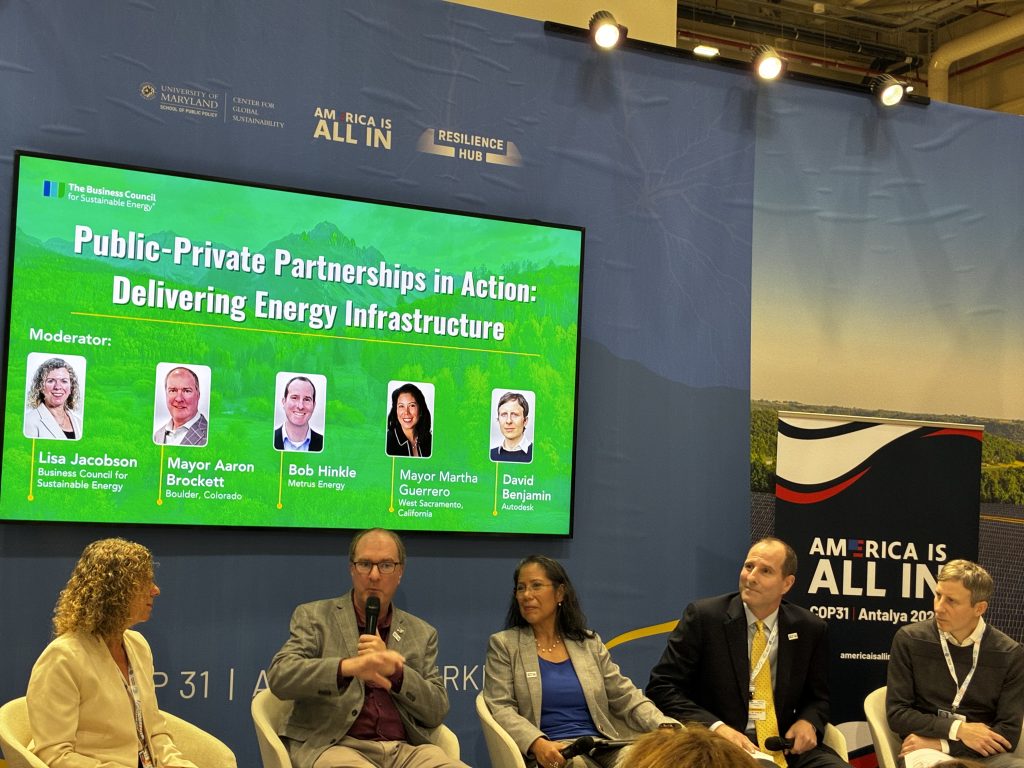
Today at the “America is all in” pavilion, Minnesota Governor Tim Walz was a surprise guest. He spoke on a panel organized by the Business Council for Sustainable Energy and discussed American examples of public-private partnerships and the country’s energy transition. He pointed out that the first mine in Minnesota has opened in many years and is operating to produce the “greenest” steel that can be produced. He also mentioned the project by which Minnesota becomes one of the leaders in the field of production of sustainable fuel for air transport and repeated the message of John Kerry, that Trump was wrong regarding his attitude towards sustainability. They pointed out that in the business of green transition a lot of progress can be made in the GDP of the United States.
In the day dedicated to finance, there were the same number of panels dedicated to this topic as in previous days. Smaller states continue to seek financial support from larger ones in various ways. In doing so, it is revealed that there are mechanisms that give incredible amounts to companies that continue to work against humanity. Businesses are “begging” members of the COP31 presidency to show them how they run their sustainable companies. Everything points to the fact that there still is money, but that it still does not go to the most necessary places.
Photo credits: Marko Macura and Perun Prodanović