
What a comparison of heating costs fails to reveal about public support, security of supply, and the distribution of benefits
We once asked, “What car is better than a Moskvitch?”—but what we really meant was, “What heating method is better than gas?” You’d never guess!
For years, the Energy Agency of the Republic of Serbia has promoted gas as the cheapest fuel for household heating in Serbia. According to data from the Statistical Office of the Republic of Serbia, this promotion is working: the number of households using gas for heating is on the rise.
A low gas heating bill is certainly an advantage for an individual household. However, a low bill is not, in itself, proof that this heating method is inexpensive for society as a whole. When the state assumes a portion of the costs, those costs do not simply vanish—the party footing the bill just changes. Your “kind and neighborly” fellow citizens are sharing the burden of your heating costs, helping to pay the bills owed to your suppliers—or, perhaps, your “relatives.”
In the Energy Agency’s table for the 2026/27 season, natural gas once again ranks among the cheapest options listed. According to our regulator, a standard 60-square-meter apartment would require 59,500 dinars for energy over the course of the heating season. The Agency notes that costs for equipment, installations, and maintenance are not included, and it concludes its overview by offering advice to citizens on choosing a heating system. However, the statement contains no information regarding public support for the gas system, nor any description of supply risks.1
For someone who already has a gas boiler—whether purchased independently or co-financed by the state (i.e., by fellow citizens)—such information may be useful for budgeting heating costs. For someone still deciding on a heating method, however, it is insufficient. It is even less adequate as a basis for concluding that gas has demonstrated an advantage under conditions comparable to those of competing heating options.
How great is the support that remains outside the official tables? How big is the heart of those who contribute to the budget of the Republic of Serbia?
To give the reader a better sense of the scale of state intervention aimed at ensuring a “pleasant gas-fueled weather”—which we have written about previously—we compared the standardized estimated cost of individual household gas heating (based on calculations by our regulators) with the support provided to Srbijagas, which includes the repayment of guaranteed loans and the offsetting of gas price differentials through the write-off of debt owed on budget-funded loans.
| Year/season | Households heated via gas (thousands) | Modeled heating cost | Paid guarantees | Debt to the state written off for direct loans | Total support |
| 2022 2021/22 | 178 | 7,48 | 8,62 | 35,00 | 43,62 |
| 2023 2022/23 | 273 | 12,44 | 21,15 | 133,80 | 154,95 |
| 2024. 2023/24 | 285 | 16,93 | 26,93 | 28,01 | 54,94 |
| Overall | — | 36,85 | 56,69 | 196,81 | 253,50 |
Over three seasons, the modeled heating cost for a growing number of households using gas amounts to approximately 36.85 billion dinars. During the same period, Srbijagas reports show 253.50 billion dinars in paid-out guarantees and written-off debts—stemming from direct budget loans intended to subsidize prices—which is roughly 6.9 times higher. While this ratio does not represent the exact subsidy rate for household bills, it provides a clear indication of who controls the “climate” that ensures such favorable gas-related conditions.
The significance of this second amount is important. Paid-out guarantees represent the state servicing loans, while the settlement of direct loans signifies the cancellation of the obligation to repay them. These figures are categorized here by the year the decision was made, even though the actual disbursement of funds may have occurred earlier. Consequently, the 253.50 billion figure is neither the total sum of new cash outlays during those three years nor the final net loss to the state budget. New credit limits and subsequent write-offs of receivables—arising from guarantees that had already been paid out—have not been added to this total. [8][9][10]
The comparison encompasses various segments: Srbijagas supplies both the industrial sector and district heating plants, not just households that use gas for direct heating. Yet, that is precisely the point of the calculation. We are not claiming that all the support went to those households; rather, we are demonstrating that public funding for the gas system is not a peripheral detail that can be casually omitted from discussions regarding the competitiveness of different heating methods.[9]
Moreover, state support for gas does not end with Srbijagas: the household energy renovation program also co-finances the purchase of gas boilers. In 2023, these accounted for about 15% of all implemented measures—a share that remains roughly the same according to available data for 2024. Thousands of households have purchased new gas boilers, thanks to the solidarity of their fellow citizens. A cheap boiler, cheap gas—let’s go, gas!
The cost did not disappear—it changed who pays for it. Long live the citizens who stand in solidarity!
In its reports, Srbijagas explicitly links the write-off of debt owed to the state—arising from budget-funded loans—to the compensation for the price differential of natural gas. Consequently, the support provided to the sector cannot be characterized entirely as the construction of gas pipelines and storage facilities. Financing current liquidity and compensating for price differentials are not the same as investing in new infrastructure.[8][9][10]
Such assistance may be justified during a crisis. While the state’s decision to protect consumers and the economy may be sound, it is problematic to disregard the impact of this intervention when subsequently comparing the “market” advantages of different energy sources. An advantage that is, in part, facilitated by the state budget should not be presented as an inherent attribute of the energy source itself—because it is not. As we have noted previously, in this context, price is truly in the eye of the beholder.
The same standard must apply to other heating methods. This analysis does not prove that any alternative is free from subsidies, public investment, or risk. Rather, it demonstrates why these factors should be accounted for in a comparable manner, rather than allowing various forms of public support to remain hidden behind a simple price ranking.
To demand that the regulator—alongside its comparison of bills—explain the public financial conditions under which these costs arise, it is not necessary to know exactly how every single dinar of support has been allocated.
Buying a boiler is not a three-month decision
According to a confirmation from Srbijagas, reported by RTS on September 30, 2026, the arrangement for the purchase of Russian gas has been extended for another three months, until the end of the year. This represents a continuation of supply under the terms previously agreed upon; it is not a long-term guarantee that these conditions will remain unchanged or that supplies will continue.[11]
A household that invests in a boiler, a connection, and the necessary installations is not merely determining its costs for the coming winter. It is committing itself to a system where the terms of supply, availability, and pricing policy will shape its future expenditures. An arrangement that appears favorable in the short term is not sufficient proof that the choice will remain advantageous in the long run. This does not imply that gas supplies will run out; the existence of reserves and alternative sources can mitigate such risks. However, security is not solely a matter of whether gas is physically available—it also depends on the cost at which replacement supplies are secured and who bears the difference in price. Any comparison intended to guide the choice of a heating system should also account for how sensitive utility bills might be to changes in these conditions.
Who benefits from the price that fellow citizens—acting in solidarity—have made possible?
Public support for the competitiveness of a particular energy source is not the same as assistance to households that face the greatest difficulty in accessing heating. Therefore, the issue of competitiveness also leads to the question of distribution: who uses gas, and who stands to gain a direct benefit from this nice gas weather?
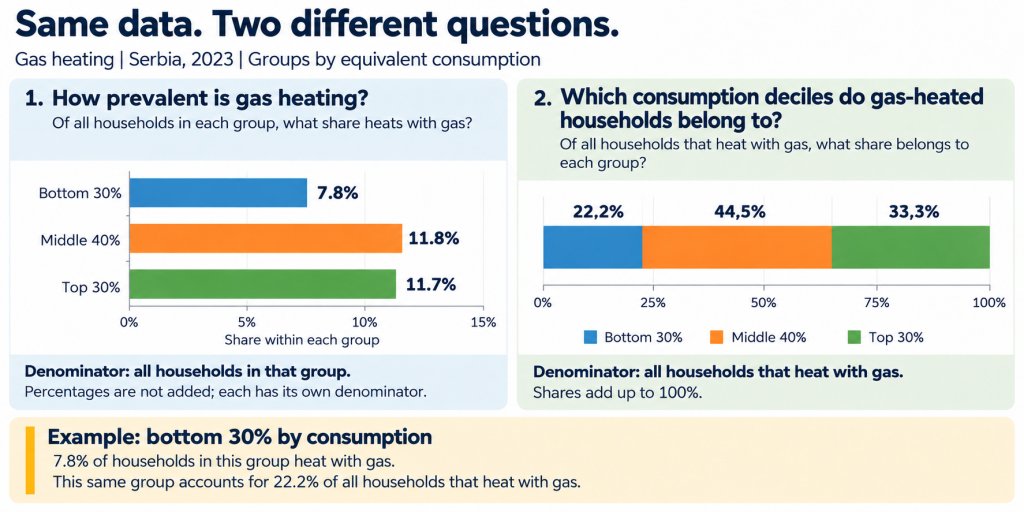
Among the 30% of households with the lowest monetary expenditure, approximately 7.8% use gas for heating. Among the 30% of households with the highest total monetary expenditure, about 11.7% use gas for heating. This reflects the prevalence of a specific heating method within a given group. When examining the composition of all households that use gas for heating, the 30% of households with the lowest monetary expenditure account for approximately 22.2% of users, while the 30% of households with the highest monetary expenditure account for 33.3% of all households that use gas for heating.[3]
These results do not indicate that gas is used exclusively by the affluent, nor do they suggest that an equal share of the subsidies reaches each group. Rather, they show that the direct benefit of a policy that lowers gas prices is not equally accessible to all consumer groups. For the majority of households in the bottom 30%, individual gas-based heating is not even the method used to heat their homes.
To determine the distribution of financial benefits, one must also consider the amount of gas consumed by each household. If assistance is delivered through a lower price per unit, higher consumption may translate into a greater absolute benefit—regardless of the actual need for support. Conversely, some of the benefits may also reach households that lack gas boilers—for instance, through district heating systems, public services, or the broader economy.
Therefore, these data do not prove that the poor are subsidizing a specific portion of the heating costs of the wealthy. This gives rise to a valid argument that the justification for such support should be evaluated based on the distribution of benefits and needs, rather than solely on the low price offered to existing users.
Support should be measured by warm homes, not just the price of gas.
The question is not whether the state should provide assistance, but rather what it aims to achieve and how it evaluates the outcomes. Not all interventions—whether they involve covering price differentials, investing in infrastructure networks, or implementing measures to reduce household energy demand—yield the same public benefit. They should be evaluated based on cost, reliability, effectiveness, and accessibility to those who need the support most.
Consequently, one should expect more from the regulator than just an arithmetically accurate table of current utility bills; there should be a clear explanation of the scope, the nature of public support, and the associated risks. From those who make budgetary decisions, one should expect an answer as to who receives this support—and whether the same funds could have generated a greater benefit.
A lower utility bill may indeed be the result of successful public policy. However, this must be demonstrated through an analysis of costs and outcomes, rather than by omitting these costs from the comparison. As long as the public expenditure remains outside the picture, such a table merely shows what the consumer pays—it does not reveal the true cost of heating to society as a whole.
Part of this narrative also involves district heating companies: they convert gas into heat, while managing their own operational costs, debts, and billing practices. This is the next area that warrants examination to understand how public support and the operations of energy utilities ultimately translate into the bills paid by citizens.
Note on calculation
Heating costs. The AERS standard is based on a 60-square-meter space, a temperature of 20°C, 16 hours of heating per day over 180 days, and a heat requirement of approximately 9,000 kilowatt-hours. The calculations do not account for actual floor area, insulation levels, weather conditions, or price fluctuations throughout the season. National estimates utilize the published total share for “gas”; the breakdown by group incorporates specific base values and percentages for each individual decile. Due to the rounding of the original percentages, their sum may deviate slightly.[2]45[3][4][5][6][7]
Support. The primary view combines guarantee payouts and the issuance of direct loans based on the year the decision was made; it does not allocate assistance across heating seasons. An alternative view, which tracks guarantee payouts and new direct loans by the year of disbursement, yields 218.51 billion dinars—approximately 5.9 times the modeled heating cost. These two figures cannot be added together. Neither represents the final net fiscal loss.[8][9][10]
Compliance of sources. For 2022, a specifically noted direct payment of 0.688 billion dinars by the Public Payments Administration (UJD) to NLB Bank is included. For 2024, the figure for guarantee payments (in dinars) is taken from Appendix 13, along with a write-off of 2.201 billion dinars from page 76—a figure that aligns with the change in the balance of loans; meanwhile, page 102 shows an unreconciled amount of 2.021 billion dinars. A write-off of 30.878 billion dinars in receivables—arising from guarantee payments—has not been added back. This represents a transparent reconstruction of the company’s reports, not an audit-reconciled budget execution.[8][10]
Sources
[2] РЗС, Анкета о потрошњи домаћинстава 2022, табела 7.5, стр. 82.
[3] РЗС, Анкета о потрошњи домаћинстава 2023, табеле 6.1 и 7.5, стр. 73 и 82.
[4] РЗС, Анкета о потрошњи домаћинстава 2024, табеле 1.1 и 7.5, стр. 15 и 82.
[5] АЕРС, Трошкови енергије за грејање, сезона 2021/2022, ред Природни гас.
[6] АЕРС, Трошкови енергије за грејање, сезона 2022/2023, ред Природни гас.
[7] АЕРС, Трошкови енергије за грејање, сезона 2023/2024, ред Природни гас.
[8] Србијагас, Извештај о пословању за 2022, стр. 77, 85-86, 104 и Прилог 13.
[9] Србијагас, Извештај о пословању за 2023, стр. 25, 78, 86, 103 и Прилог 13.
[10] Србијагас, Извештај о пословању за 2024, стр. 13, 76, 84-85, 102 и Прилог 13.
[11] РТС, Гасни аранжман са Русијом продужен до краја године под истим условима, 30. септембар 2026.