
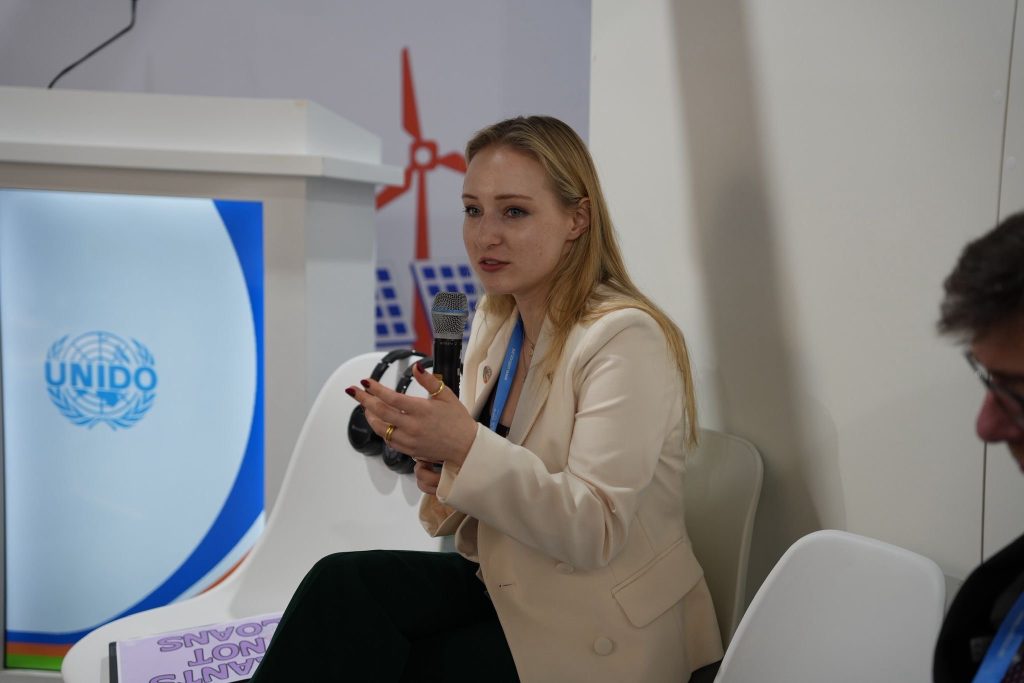
#RESTalksCOP is a COP30 interview series created to bring people closer to the United Nations Framework Convention on Climate Change (UNFCCC) process. Through conversations with negotiators, experts, and civil society, we explore diverse perspectives and behind-the-scenes insights. Recorded on the ground at the 30th Conference of the Parties (COP30), these interviews offer a time-capsule look at the people and stories shaping today’s climate negotiations.
We spoke with Bianca Garvin, who works on industrial decarbonization within Mission Possible Partnership and follows the UNFCCC negotiations on Article 2.1(c) of the Paris Agreement, contributing youth positioning on this agenda point for COP30. In our conversation, she reflects on the challenges of aligning global financial flows with a 1.5°C pathway, the persistent gaps in adaptation finance, and the need to better connect public finance, private capital, industry, and insurers to meet global climate needs.
Bianca Garvin: Hi, I’m Bianca Garvin. I’m currently working at Mission Possible Partnership, specifically in the Industrial Transition Accelerator, which is a time-bound initiative to accelerate clean industrial projects reaching Final Investment Decision (FID). It was set up by the COP28 Presidency, so there is a strong COP-to-COP connectivity. Outside of my day job, I also follow the climate negotiations, especially Article 2.1(c), so I’ve been doing that for a while and I wrote some of the positioning for Article 2.1(c) from the global youth perspective for COP30. I’m originally Finnish and Danish.
Zvezdana Božović: How long have you been involved in the UNFCCC process?
Bianca: I’ve been around COPs since COP26, but it was only in the Green Zone at the time. I was studying in the UK and I thought: “If it’s in the same country, I have to make it.” It was very inspiring, and I have been to each COP since then. So it’s my fifth time in this system.
Zvezdana: What are you following at the COP this year?
Bianca: I’ve been following the Article 2.1(c) negotiations with one eye, although since I am here for my day job, that’s been taking up most of my time, where I am working on the Action Agenda implementation. 2.1(c) specifically talks about how we can align global financial flows with a 1.5 degree trajectory, and they’re coming to a decision on it at COP. Basically, the work program on that article was closed earlier in Rome in September and now they’re discussing how to take it forward since, needless to say, global financial flows are not aligned with 1.5 degrees yet, so there is still a lot of work that needs to be done.
Zvezdana: The decision on the New Collective Quantified Goal on Climate Finance (NCQG) last year was widely criticized by a lot of Parties and by civil society for being insufficient. We see that there is now work being done to see how we can now scale up to meet the 1.3 trillion goal set by the NCQG through the Baku to Belém roadmap. Where do you see opportunities and where do you see obstacles for this 1.3 trillion goal to be met?
Bianca: Again, I have not been following the negotiations extremely closely, but there seems to have been a noticeable lack of financing pledges recently. And while pledges are one thing, the key is implementation and operationalization of the mechanisms and finance flows, in a very transparent manner and in a way that leads to on-the-ground impacts for adaptation and mitigation. Adaptation’s been a big topic at this COP which I think is good because it also brings attention to the need for adaptation finance. It is a difficult area because it’s hard to make the business case for adaptation and there are a lot of discussions on how to find the financing. Adaptation finance is generally in grant-based form, which again means these are public funds that need to be granted by Multilateral Development Banks (MDBs), or countries, into adaptation. Funding needs to come from public sources for a lot of projects and there hasn’t really been sufficient momentum on that during this COP – but the fact that these conversations are going on can hopefully raise the profile of the massive needs for adaptation, and unlock some capital towards it There has also been a very loud civil society voice which can hopefully draw more attention.
Zvezdana: Do you think that the finance should primarily come from the public sector, or are there any other important actors who can contribute to the 1.3 trillion goal?
Personally, I believe the private sector has a very large role to play as well in helping mobilize this 1.3 trillion. Yet COP is a Party-led process so I still believe the discussions on the role of the private sector should come from outside the COP. Here, the question of climate finance is not just about unlocking money, but about historical responsibilities, global justice and just transition. Historical polluters do have a responsibility to pay and that should also include recently developed and emerging countries. An example is China, which has contributed a significant share of emissions. China has actually made pledges towards climate finance, but this should happen more systemically for all such countries. These conversations should happen within the Party-led process of COP, on how to unlock financing from emerging countries, who have caused a very large part of global emissions.
So on private finance – mobilizing private capital is key but shouldn’t dilute the responsibility of Parties. On the contrary, I think Parties should be taking on more responsibility in unlocking finance. We also can’t underestimate the role of the private sector, and a lot of the conversations that are happening outside the negotiation rooms with some private financiers and others are very valuable. There is quite a low industry presence at the COP, which, on one hand is good, because it lends more space for civil society. On the other hand, it’s really valuable for industry to be here as well and to see the momentum and to see that there is a business case in clean, green projects, whatever industry it may be. So that’s one where there could be a bit more focus.
Zvezdana: You mentioned before that adaptation in particular is quite a difficult business case to make, especially when trying to raise funds and find collaboration pathways with the private sector. Why do you think that is?
Bianca: Overall, if you are doing an adaptation project, you’re avoiding a risk in the future, but it’s not something that will oftentimes generate returns. For instance, if you build a seawall to prevent flooding, it’s a huge infrastructure project, but you’re not really creating revenue. There’s no ongoing cash flow that comes from it. The point where the investment makes sense is if there’s a flood and then you avoid a loss from those climate-related disasters. But in the short term it won’t, and often financing is unfortunately very short-termist, that’s why adaptation’s a very difficult one. It’s also very hard to create some adaptation projects, because we’re all dealing with a climate crisis where we can’t anticipate what effects are actually happening in the short term, nor in the long term. So it’s quite difficult to model. I think that’s where innovation comes into play as well. For instance, using innovative building materials and bio-based adaptation I think are really fascinating. The very sort of cliché example is mangroves, but they’ll capture a lot of CO2, they help with adaptation because they help strengthen coastlines, and they can also host so much biodiversity. We need to look at all those co-benefits which are hard to quantify and they’re hard to put on a balance sheet, but there’s so much value that’s created from a lot of adaptation projects as well. When investors want to make an investment, they want to see what the returns are going to be on the investment. That’s why it’s hard to make a business case. But that’s where the insurance industry can play a much larger role, and they need to be included in these financing conversations more. Insurance is getting more expensive, so having some sort of adaptation system in place and maybe looking at innovative financing tools with them can be a way to fund adaptation.
Zvezdana: I find it really great that you’ve mentioned the role of insurance, because it definitely isn’t discussed enough. This year, insurance is quite present through the Insurance House which is also close to the conference venue. In terms of engaging the private sector, including insurance, the issue with adaptation finance is that it is also often untracked. How do we bridge the gap between what we know to be the needs on the ground, what actors are doing individually, and what can be done through public-private partnerships? How to make it profitable for investors, make it make sense for the market?
Bianca: It’s a 1.3 trillion dollar question!(laughs) Not a billion dollar question, but a 1.3 trillion dollar question.
I’ll actually refer to what I do a lot in my day job, which is tangentially related, working in clean industry, to get these big commercial-scale projects to FID (Final Investment Decision) by supporting them on the ground, and I really believe in the value of this model that we use. There is financing available, there are a lot of disjointed axes so value chain orchestration can bring the right people to the table to discuss what should be done. Each actor , whether it’s finance, governments, civil society, project developers, can share what roadblocks they’re having in getting these projects over the line, and then they can work together, maybe bring in some third player that can bring in a solution, an innovative financing platform, for instance. So that’s one thing – by providing very targeted support with a specific group of stakeholders, you can have significant and positive impact on a given project. It’s a scalable solution, but it usually works for one project at a time and you need a lot of resources and convening power to do that.
Another model which has been done a lot within the UN negotiations is, especially at the Meetings of the Subsidiary Bodies to the UNFCCC (SBs) for Article 2.1(c), is that in the consultations they’ll bring in experts from the insurance sector, academia, private sector, finance, other stakeholder groups to give presentations to the Parties before they actually go into discussions. That’s another way to raise awareness among the Parties of the need for more collaboration and really bridge those information gaps. But ultimately, I believe it’s not really going to happen until you’ve got all those different stakeholders on an equal level at a table talking and taking action after.
Zvezdana: Do you think that the COP as it is now would be a good platform to carry this out?
Bianca: That’s an excellent question. I think the COP system has a lot of silos. You find a lot of things, and then the connections are often missing. For instance, this past week, I’ve been very focused on the Action Agenda, which is being led by the Climate High-Level Champions – think of it as the implementation arm of the COP system for all of the non-Party stakeholders – but while doing this, I haven’t been that in touch with the negotiations with the Parties. Then in addition to all of this, there’s all the things going on with the pavilions and with civil society demonstrations. We have the right people in this space, but they’re not always talking to each other. I think one of the logistical challenges with COP is that negotiators are meant to be in negotiation rooms, everyone is in their own space. More opportunities for collaboration and just more engagements throughout the year would be really beneficial, so that we don’t just come together once at COP for two weeks to discuss this. I think more ongoing dialogue and more conversations would be really valuable.
Zvezdana: Thank you so much for taking the time to talk to me. If people are interested in learning more about your work, where can they find you?
Bianca: Thanks for talking to me and letting me share some of my experience. You can find me on Linkedin, Bianca Garvin, or on Instagram, @biancagvn.
Interview conducted on 17 November 2025