
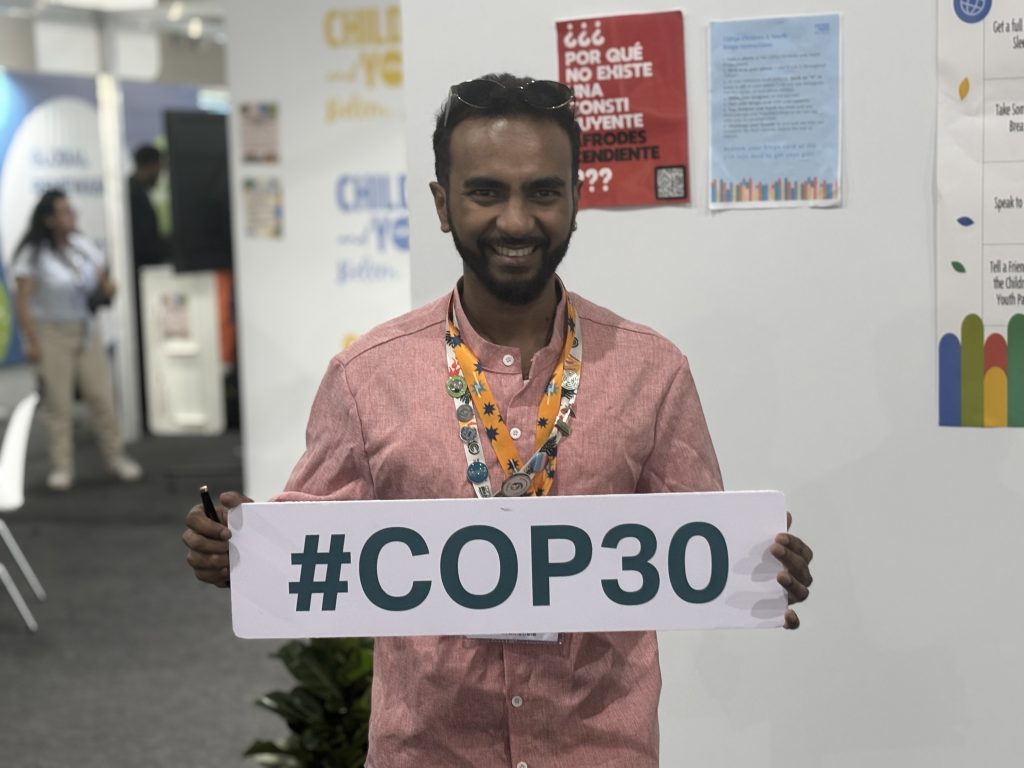
#RESTalksCOP is a COP30 interview series created to bring people closer to the United Nations Framework Convention on Climate Change (UNFCCC) process. Through conversations with negotiators, experts, and civil society, we explore diverse perspectives and behind-the-scenes insights. Recorded on the ground at the 30th Conference of the Parties (COP30), these interviews offer a time-capsule look at the people and stories shaping today’s climate negotiations.
We spoke with Saikat Das, Contact Point of the Energy Working Group of the Official Children and Youth Constituency to the UNFCCC (YOUNGO) and advisor at the Global Renewables Alliance, whose work spans UNFCCC advocacy, international energy diplomacy, and global offshore wind development. At COP30, Saikat is championing the need for a dedicated energy negotiation track and pushing forward the GST 2.0 – 3F Campaign. In this conversation, he reflects on the gaps in the current process, the geopolitical and financial barriers to energy transformation, and why system change is essential to meeting global climate goals.
Saikat Das: First, I’m really happy to be here as we’ve been friends and colleagues in the energy space for a while now. I think the first time we met was in Bonn, when we worked together on a joint press conference pushing for a dedicated energy negotiation track. Of course, we’ll get into that, but let me start with a brief introduction. I’m Saikat. I am the Contact Point of the YOUNGO Energy Working Group. I also work with the Global Renewables Alliance within the International Renewable Energy Agency (IRENA) as an advisor on international partnerships, and in my full-time role I’m a commercial manager for offshore wind projects at a UK-based company. I wear several hats, much like you, working in this climate space.
Zvezdana Božović: That is true, we do wear a lot of hats in this space. So how long have you been involved in the UNFCCC process?
Saikat: Since I came to this Earth, everything is a negotiation. But when it comes to the UNFCCC negotiations, it has been five or six years I’ve been following the negotiations. We are not on track for 1.5 and right now we are tracking for 2. Maybe in a few years we’ll say 2.5. We are currently in a place in the negotiations with no conclusion.
Zvezdana: It seems like energy is on everyone’s minds, but at the same time, there is no dedicated track that really zeroes in on this interrelation between energy and climate change. During those years, how have you seen energy progress through the negotiations?
Saikat: It’s a very important topic. As I mentioned before, we were doing this press conference discussing this specific topic. We have been talking about energy for so long, for decades, but we are not on track for 1.5 at all.
It’s because energy systems account for roughly 70% of global anthropogenic CO₂ emissions, so when we talk about such a large share of emissions, it’s clear that we need a dedicated space in the negotiations to address it directly. Right now, we talk about mitigation and adaptation, which are of course crucial, but energy underpins every aspect of climate action. As an energy practitioner, I won’t call myself an expert, but as someone who works on implementation, I have to follow five or six different negotiation tracks which is exhausting. Most parts of these tracks are not fully covering energy. I’d say maybe 25% to 30% of what they cover includes energy, which is high enough to warrant our attention. So we follow energy scattered across these tracks. This is why we need a dedicated energy negotiation track in order to have a mechanism to track those parameters, how far we’ve come, like a stocktake.
Zvezdana: Something like a “Global Energy Stocktake”?
Saikat: Well, you’ve just touched a nerve, because this year I am trying to launch a big campaign called “Global Stocktake 2.0”, but we’re branding it as the “3F Campaign — fair, fast, and furtherance”. It should be fair because in Dubai we saw that some Parties, especially SIDS and other small developing nations were not properly included. Furtherance, because until now the modalities and processes for implementing the GST outcomes are still unclear. In the first GST, we can see the timeline and short- and long-term goals, but we don’t see the implementation mechanism, how to actually track progress. For example, among the new nationally determined contributions (NDCs) that have been submitted, only 44% of NDCs have a track on renewable energy. That implies we need roughly 600 GW of added renewable capacity by 2030, but there is no mechanism to track how countries will deliver that. All the previous lessons learnt should also be included. Finally, it has to be fast because we don’t have much time and GST 2.0 needs to reflect this. This is why “GST 2.0 – 3F” is really crucial for us.
Zvezdana: You’ve been on the ground for a couple of days already here at the COP. Among the people you’ve been speaking with, is there optimism or caution about the outcome of the negotiations and what that means for energy in the UNFCCC?
Saikat: I am optimistic. You can see why from many reports, including IRENA’s. Last year, global investment in renewable energy surpassed investment in fossil fuels by 2 trillion dollars. We are about to go 1120 terawatt per hour by 2035. That’s a huge opportunity. Last year we had nearly 550 gigawatt hours of inclusion of renewable energies into the system which is really great. The cost is moving dramatically down for renewable systems, specifically wind and solar. However, there is also a lot of lobbying from the fossil fuel industry. The fossil fuel phase-out is not done yet. We hear things like “transitioning away” and “keeping science behind” but exactly when, how, how long, remains unknown.
This is what makes us keep pushing. We need to also change the narrative and change the system. System change is very important and always includes a lot of important socio-economic aspects, cost-benefit analyses, just energy transition which we are now discussing. Climate finance is also connected to this through the Baku to Belém Roadmap. I think we are optimistic. The numbers don’t lie. The data says that over 2 billion people are deprived from access to clean cooking and over 600 million people lack access to electricity. The numbers say it all. We have to do it.
Zvezdana: In this movement to push for renewables and more energy equity, what are the main obstacles right now? Perhaps something in the negotiation process or the broader geopolitical context?
Saikat: You’ll get many different answers to this question. Personally, I am an advocate, so I look at things through the lens of science, business and socio-economic angles and geopolitics. Geopolitics is full of paradoxes. For example, time is everywhere, but it’s never free. Energy negotiations feel similar -everything depends on something else. Last year’s outcomes on the New Quantified Goal on Climate Finance (NCQG) was viewed by many as a failure, but we are still moving ahead to meet the 1.3 trillion goal. It’s a figure we are pushing towards. Most financial institutions are concentrated in major economies and most finance is debt-based rather than grant-based. We need a flow of grant-based finance as per Article 2.1(c) or Article 9.1. of Paris. Public-private funding can contribute to this and subsidies can go towards renewable energy. We also have to decouple GDP from emissions. If we have high GDP but it is directly proportional to emissions, it makes no sense. Only when we have high GDP and low emissions can we say a country is doing good.
Zvezdana: So you would say the main obstacle is finance, and your second point if I understand correctly is more abstract and refers to how we presently measure economic development and growth?
Saikat: Yes, exactly.
For example, historically, the US dollar went through several phases of how its value was measured. It was tied to gold, then when the standard ended, and over time, international markets increasingly used the dollar to price commodities, particularly oil. This created a strong link between global oil markets and the dollar so if one rises or falls, it has consequences for the other. Even countries which don’t domestically use this currency are affected because of global trade. What we need to rethink is how we can un-link these systems. Same goes for GDP and emissions, tariff rates and the Carbon Border Adjustment Mechanism (CBAM). System change is key.
Zvezdana: What projects would you like to spotlight?
Saikat: GST 2.0 is really important because by now we should have finished with implementation and moved to scaling up, but I don’t see any implementation because there is a problem in the modalities and procedures. We have to also wait and see if we will get the 7th Assessment Report (AR7) of the Intergovernmental Panel on Climate Change (IPCC) in time for the GST. We will see, we are optimistic about the outcome. We are here in the heat, everyone is supporting each other.
Zvezdana: Thank you so much for taking the time to talk to me! Where can people find you if they want to know more about your work?
Saikat: If you search for saikat.co.uk, you will find my website with all my work links to LinkedIn and other spaces. As for my working group, we are the first one to have our own website at youngoenergy.org.
Interview conducted on 13 November 2025