
#RESTalksCOP is a COP30 interview series created to bring people closer to the United Nations Framework Convention on Climate Change (UNFCCC) process. Through conversations with negotiators, experts, and civil society, we explore diverse perspectives and behind-the-scenes insights. Recorded on the ground at the 30th Conference of the Parties (COP30), these interviews offer a time-capsule look at the people and stories shaping today’s climate negotiations.
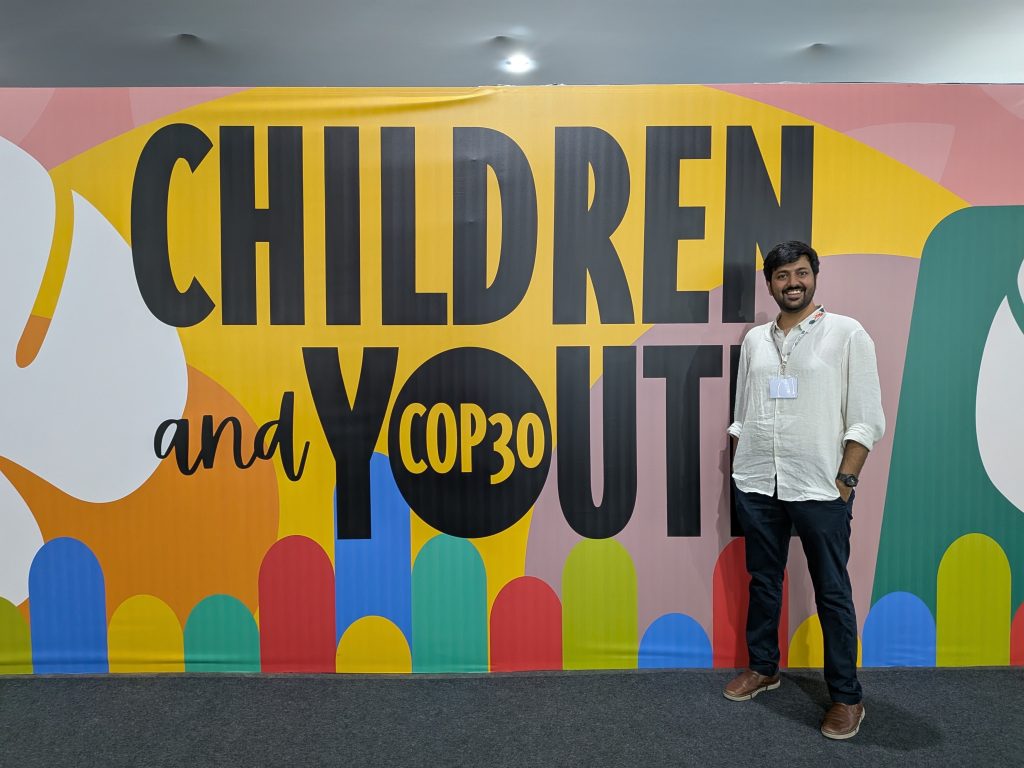
We spoke with Shaurya Patel, a researcher working at the intersection of climate science, mitigation, and policy, currently serving as a chapter scientist for the Special Report on Climate Change and Cities of the Intergovernmental Panel on Climate Change (IPCC). Shaurya shares his perspective on the Mitigation Work Programme (MWP), its evolving role, the linkages with the Global Stocktake (GST), and the challenges of aligning science and policy in a rapidly narrowing window for climate action.
Shaurya Patel: I’m Shaurya. I’m from India and I work in the space of climate mitigation, sustainable development and international relations. One of the hats I wear is also of chapter scientist for the IPCC’s Special Report on Climate Change and Cities, and I am also a research associate at the Ahmedabad University in India where we specifically look at climate policy and governance and how it influences the mitigation of climate change.
Zvezdana Božović: How long have you been involved in the UNFCCC process?
Shaurya: I work specifically at the science-policy interface of climate change. Before coming to the UNFCCC, I was working with the technical support unit of the IPCC and the co-chair of Working Group 3 where I was supporting them for the AR6 cycle, specifically on the mitigation reports. My understanding of climate change started with the science side of it, and then slowly my interest started evolving with climate change mitigation and the policy side. I then started looking into the governance of it, the UNFCCC and all the rest of it. I would say now it would be five years.
Zvezdana: What are you following this year at COP30?
Shaurya: At the moment, I am following three tracks. One is the UAE Dialogue, the Global Stocktake, and the Mitigation Work Programme (MWP). However, currently I am more focused on the Mitigation Work Programme.
Zvezdana: So far because it’s already been almost a week and a half since the start of the COP, what developments have you noticed in the MWP discussions? How has it been positioned in the agenda?
Shaurya: In terms of negotiations, it’s only in COP27 that we got mitigation as a separate work programme, so it’s been three years. It’s a very early development compared to other tracks, so more or less the maturing of the MWP is still underway. It hasn’t matured, it hasn’t stabilized. Therefore we see a lot of negotiations happening right now and there’s no consensus specifically on what kind of program it would evolve into in the future. The big contestation is the issue of the timeline for the MWP because it ends in 2026. Should it be continued? That’s the question many negotiators are asking. The other question that is emerging is around its linkages with the Global Stocktake. The biggest question right now is the availability of science and how it’s interlinked with the MWP. However, there is little consensus on the creation of the platform, but the details are still under negotiation. That’s what the MWP is at the moment. The emphasis, as reflected in the COP Presidency’s priorities, is on the GGA and other tracks which have slightly more priority compared to the MWP, but that’s partly because it’s still an early stage negotiation.
Zvezdana: How do you see the future of the MWP shaping up in the next two years?
Shaurya: For the next two years, I would say, the sooner they have a consensus on at least a couple of items, the better. For example, a digital platform, as one of the negotiators mentioned right now, since the Paris Agreement was accepted in 2015, and we only started working on it three years ago before we got the means of implementation. That doesn’t mean that we don’t know what the digital platform would be like. There is this force to build that digital platform because it allows for different forms of businesses, different forms of emissions reduction strategies that other countries and other companies and organizations could actually adopt and implement. So there’s strength to it, but that strength only would take shape once you have this architecture for the digital platform, because that’s the priority I would say at the moment.
For two years down the line, the question right now is whether this program would even extend or not. That’s the big question. More or less, I would say it’s going to be extended because we do need best case studies as to how we can reduce emissions and there could be technology transfers, or there could be capacity building, at least under this program in the long term.
Zvezdana: How would this continuation reflect on developing countries?
Shaurya: That would be very useful for developing countries because they have been asking for the technology transfer, capacity building and finances the last twenty to twenty-five years of the negotiations.
Zvezdana: As you mentioned, you are coming from a more scientific background, slowly transitioning into policy. Throughout this transition, would you say there are still obstacles in communication between science and policy, or would you say that both are moving in the same direction?
Shaurya: Science has its own timeline, I would say. For a research article, a person or a team of researchers studies the topic, they publish it. It has its own, slow process. It’s incremental, but it’s also very robust. So the question about policy is how robust can the policy be based on the science that we have? You can’t rush science, that’s for sure. You need its own time to build and then you start reshaping policy. However, there are certain cases where you would absolutely need a new form of policy. Then you need to put funding into research and development so that you can get the answers that you are looking for. Parties and countries might have to think about different ways if they are trying to solve a problem, but they need to put research and development into it, and that takes its own time. But more or less, I would say science and policy are integrated.
Zvezdana: For the MWP in particular, would you say that there are already some points that are emerging as really strong common themes in the negotiations or strong demands from multiple Parties? Or is there still a dissonance in what is expected from the programme?
Shaurya: One of the strong demands from the Environmental Integrity Group (EIG) is to have reference to IPCC and the reference to the 1.5 degree Celsius target. That’s one of the key demands. The Like-Minded Developing Countries (LMDCs) and the Alliance of Small Island States (AOSIS) have more or less agreed to that, but it’s still under process right now as we speak. These are the two big points that are emerging, more or less. The assumption is that we might end up having at least consensus on having a digital platform, though we might not launch it immediately. That is where the discussions are heading.
Zvezdana: You mentioned that you can’t rush science, but would you say that in some ways you also can’t rush policy? In the past years, there have been moments at the COPs where Parties were pressured into having a decision for the sake of having a decision, ending up disappointed or at least very critical of the outcomes. How do we find the good balance between the speed of policymaking and the quality of the actual end result?
Shaurya: Interesting question. The 6th Assesment Report (AR6) tells us that we need to reduce our emissions by half by 2025. We are already done with 2025. This is now November, and we haven’t done that. Once we peak, we start reducing our emissions if we want to keep the 1.5 budget alive. Then we need to go until 2050 to reduce, going to net zero. There is this huge science push that is emerging. At the same time, policies are struggling, because policies are far bigger in terms of their webs. They include businesses, societies, different interest groups working together.
Forming a win-win policy, it has its own process, but who is winning? Or who is losing? Because you can’t have a policy that could impact vulnerable people even further. That’s where negotiators are being very careful. This makes more sense because you want to deliver justice as well in the process. You have to be inclusive of what is happening and how it is happening. That’s where I think science is just giving you that information, and now it’s up to the policymaker to make the case that within his or her own country these are the ways that we can actually solve things. Could we bring more incentives? Could we have more subsidies? Could we transition away from fossil fuels? Those are the questions most of us are asking.
Zvezdana: Thank you so much for your insights. Would you like to share or spotlight some projects that you are working on right now?
Shaurya: As I mentioned, I am a chapter scientist for the Special Report on Climate Change and Cities (IPCC). We are looking at climate change in cities, that’s one of the projects I am working on. The other one that I’m doing is on understanding the Global Stocktake and its influence on the Nationally Determined Contributions (NDC) process, the mitigation track and the adaptation track, and to see how the outcomes of the 2023 GST actually reshaping the dynamics of the negotiations. So far I can see yes, but whether it is successful or not is something that I am looking at.
Zvezdana: Sounds really interesting! If people want to know more about your work, where can they find you?
Shaurya: On LinkedIn, I would say.
Interview conducted on 17 November 2025